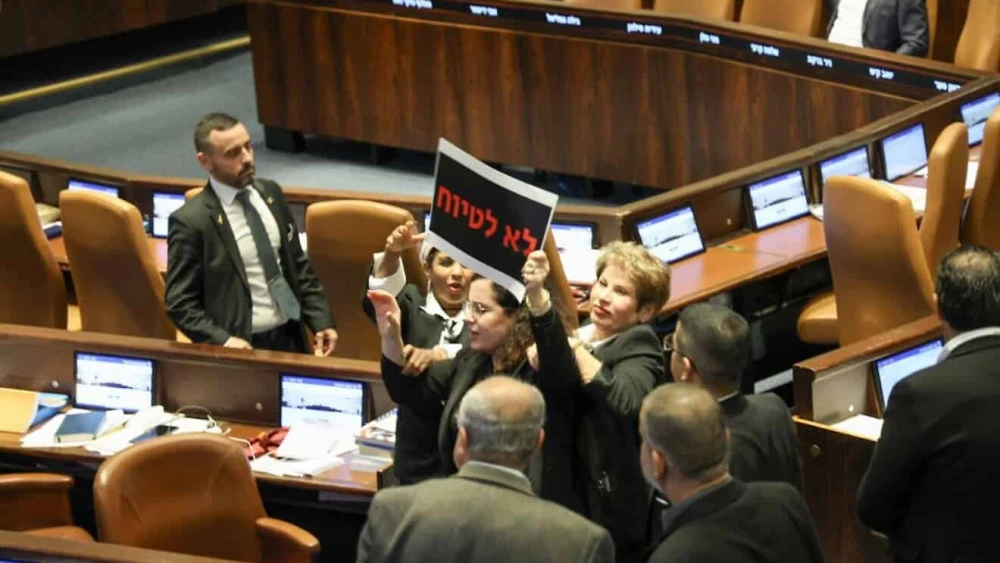
Three bills sponsored by members of Yashar party chairman Gadi Eisenkot’s bloc advanced through their preliminary readings on Wednesday, while four were struck down.
Fulfilling one of Eisenkot’s campaign promises, one of the bills to advance involves the establishment of a state commission of inquiry into the events leading up to Oct. 7, 2023. It passed 65-50.
The legislation calls for an initial allocation of 7 million shekels ($2.1 million) to fund a five-person commission that would investigate events from the conclusion of “Operation Protective Edge” in August 2014 through January 2026, when the remains of the last hostage in Gaza were returned to Israel. The commission would be required to publish an interim report within one year of its establishment.
“These are words that should have been written three years ago. Better now than never,” wrote Eisenkot on X. “For the bereaved families, for the survivors of captivity and those who did not return to us alive, for the residents of the south and the north, for the soldiers, for Israel’s security and for all Israeli citizens, we will uncover the truth and take every step to prevent the next disaster.”
Israeli Transport Minister Miri Regev harshly criticized the bill, saying it would not lead to an investigation into the events but rather into “our brave and heroic soldiers.”
The Knesset also advanced bills establishing term limits for the prime minister and repealing a law giving the Israeli justice minister control over the Department for Internal Police Investigations.
The term limits bill, which passed its preliminary reading 65-48, proposes amending Basic Law: The Government to require that any person who serves eight consecutive years as prime minister cannot return to the position until after an eight-year hiatus outside the government.
It also states that any MK facing a pending indictment for a felony cannot be assigned the task of forming a government unless the chairman of the Central Elections Committee determines that the alleged offense does not involve moral turpitude. It would not take effect until the 27th Knesset but would apply retroactively to previous consecutive terms as prime minister.
The final bill, which passed its preliminary reading 62-48, aims to repeal a June law passed under Israeli Prime Minister Benjamin Netanyahu. If enacted, the legislation would remove the power of the justice minister to appoint a majority of the members of a committee tasked with choosing the department’s director and return the department to the authority of professional prosecutors.
The three bills must each pass three additional readings to become law.
The Knesset also rejected four bills. One, sponsored by Otzma Yehudit lawmakers and championed by Israeli National Security Minister Itamar Ben-Gvir, sought to restrict the use of loudspeakers at mosques announcing the Muslim call to prayer. It was defeated 63-45, with many Haredi lawmakers abstaining.
Known informally as the “muezzin bill,” it would have required mosques to obtain special approval from the environmental protection minister for the loudspeaker systems. It would also have authorized Israeli police to stop their operation, seize equipment and impose administrative fines of up to 50,000 shekels (approximately $15,000) for violations.
In a statement, Otzma Yehudit said those who opposed the bill had joined “forces with terror supporters.”
Israel’s parliament also struck down two bills aimed at suspending arrests of draft evaders.
One bill, sponsored by United Torah Judaism MKs Meir Porush and Eliakim Stark, proposed a one-year freeze on arrests and other enforcement proceedings against qualifying yeshivah students. A second, introduced by Shas, sought to halt arrests of draft evaders until a new government is formed. Both bills were defeated by a vote of 63-49.
By a vote of 62-51, the Knesset also rejected legislation that would have banned Israel from returning the bodies of terrorists killed while carrying out attacks to their families.
It was introduced by Religious Zionism Party MK Zvi Mor and would have required them to be buried in cemeteries reserved for enemy combatants, with the prime minister able to authorize the return of bodies under special circumstances.