“At its heart, Chanukah is about family, tradition and gratitude,” Rep. Josh Gottheimer (D-N.J.) told JNS. “It’s the small moments, like making latkes and lighting candles together, that remind us what we’re fighting to protect.”
“This year, my message to Jewish Americans is to be proud and be present,” the Jewish congressman said. “Light the candles, share the holiday with your neighbors and don’t hide who you are.”
Ahead of Chanukah, an eight-day holiday that begins on the evening of Dec. 4 this year, JNS asked Jewish elected officials to reflect on the personal significance to them of the Festival of Lights and the lessons that they draw from the holiday.
The perseverance of the Maccabees, Gottheimer said, is particularly relevant amid rising Jew-hatred in the United States and abroad.
“Chanukah is also a story of strength,” he told JNS. “The Maccabees were a small band of people, who refused to give up their faith, even when the odds were stacked against them. They stood up, held their ground and won the right to live as Jews, openly and proudly.”
“That courage has carried our people through thousands of years, and it speaks to this moment,” Gottheimer said. “At a time when antisemitism is on the rise here at home and around the world, the story of the Maccabees reminds us that we have always faced hatred with resolve and that our endurance is our greatest strength.”
“We are stronger when we stand together, and I’m grateful to be fighting for our community every day,” he said.
Simcha Eichenstein, an Orthodox Jewish New York state Assembly member who represents parts of Brooklyn, told JNS that lighting the menorah each Chanukah brings to mind a photograph of another Jewish family’s menorah taken in Germany in the years preceding the Holocaust.
The iconic photograph depicts a menorah on a windowsill overlooking a building with a large Nazi banner.
“To me, that image remains one of the most poignant symbols of courage and defiance during that tragic and terrifying era,” Eichenstein told JNS.
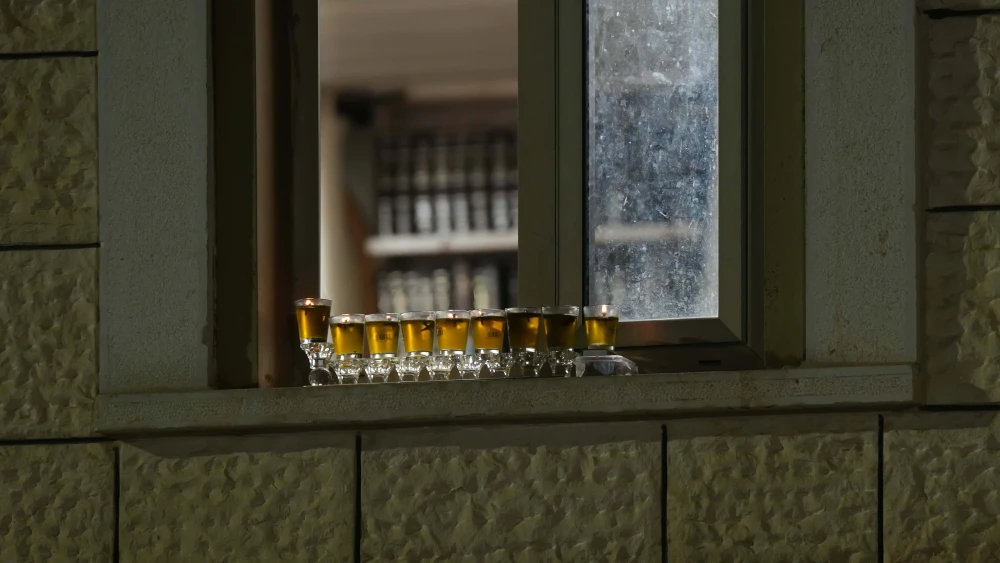
“Every year on Chanukah, as I light my own menorah on my windowsill, I think about that menorah,” he said. “Here in Borough Park, I look out and see dozens of menorahs. Their candles twinkle across the street and throughout the surrounding neighborhood.”
“It is a beautiful and comforting sight,” he told JNS. “Yet, even as those candles shine, we know that antisemitism remains very much alive in our world today.”
Eichenstein sometimes wonders whether, if confronted with the same dangers as the Posner family, whose menorah overlooked the Nazi banner, he would have the courage to make such a public display of his Jewish identity.
“Honestly, I don’t know,” he told JNS.
“But every year, when I address the Assembly chamber on Holocaust Remembrance Day, reminding my colleagues of the atrocities of the Nazi era and urging them to confront antisemitism in every form, I hope I am doing my small part,” he said. “It’s my own way of standing up to hate.”
The Hasmoneans “would surely be proud of the Posner family,” he told JNS. “I can only hope that they would be proud of me, too.”
For Ari Brown, a Republican New York state Assembly member who represents parts of Long Island, the story of Chanukah serves as a warning against divisions within the Jewish community.
“The Maccabees weren’t just fighting the Greeks. They were fighting fellow Jews, who had turned their backs on their own faith and traditions,” Brown told JNS. “Sound familiar? More than 2,000 years later, how much has really changed?”
“One of the most painful lessons of Jewish history is that our greatest struggles haven’t always come from our enemies,” he said. “Too often, we’ve been divided from within, with some Jews choosing acceptance, political convenience or personal interests over standing with their own people.”
Brown draws parallels between the story of the Maccabees and his experience in the state legislature.
“As the last Jewish Republican in the New York state Assembly, I understand what it means to stand alone, but I stand strong,” he told JNS. “Chanukah reminds us that being in the minority doesn’t make you wrong, and being in the majority doesn’t make you right.”
“The Maccabees weren’t interested in popularity or political correctness,” he said. “They knew who they were, what they believed and what was worth fighting for. That’s a lesson our people desperately need to remember today.”
Sam Berger, a Jewish New York state Assembly member who represents parts of Queens, told JNS that the significance of Chanukah lies, for him, in the Jewish traditions passed down through generations.
“The Talmud teaches us that the mitzvah of Chanukah begins with a light for each household” and that “we add another flame each night, increasing in light,” he said.
“I think there’s something beautiful in that idea,” he told JNS. “Judaism is built around family, mesorah,” or tradition, “and the responsibility to bring a little more light into the world each day.”
Among Berger’s fondest memories of the holiday are eating his mother’s latkes, unwrapping presents and playing dreidel with his grandparents and siblings and welcoming guests into his family’s home for a holiday meal.
“Those moments are what make the holiday so meaningful and remind me that the mesorah we share is what carries our light from one generation to the next,” he told JNS.