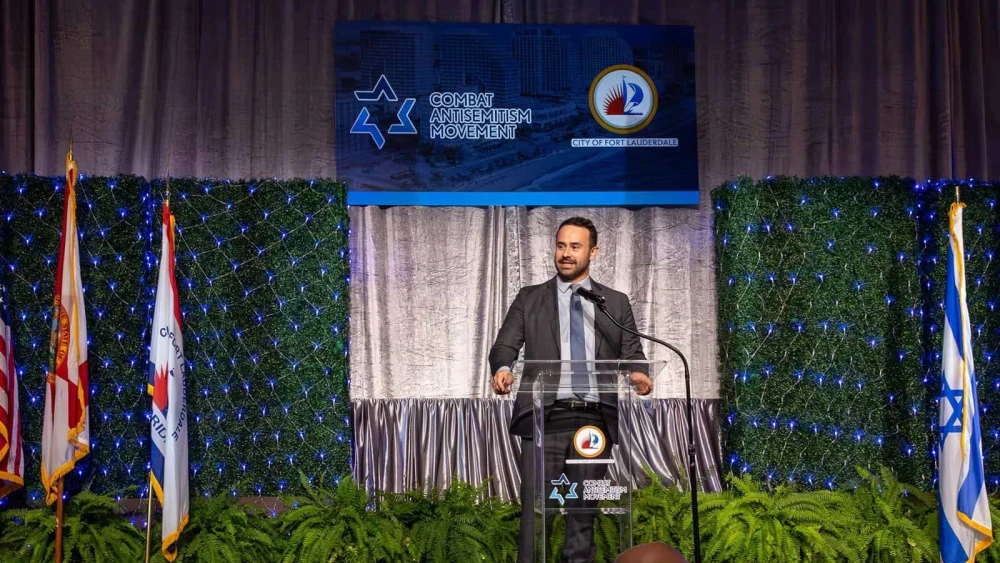
States like Arkansas, Oklahoma, North Carolina and Utah may not be major centers of Jewish life in America, but judging by the attendance of their lawmakers at the Combat Antisemitism Movement’s state leadership summit, they are at the forefront of the battle to combat Jew-hatred.
JNS spoke with Sacha Roytman, CEO of the movement, about why nearly 150 legislators and executive officials, mostly non-Jewish and mostly from states with small Jewish populations, travelled to Charleston, S.C., last week to fight Jew-hatred.
“There are Jews in almost every state in America and there are even small communities in certain states that are also under threat and under attack,” Roytman said. “It’s foreign influence in every state. You can find Qatari involvement regardless of the number of Jews living there.”
“A lot of small states understand this,” he said. “They also understand that they have power.”
CAM’s state tracker of legislative activity to fight Jew-hatred bears out the notion that many states in the South and west of the Mississippi are doing more to tackle antisemitism than the states with the largest Jewish populations like New York, New Jersey and California.
Roytman said that his group focuses on “passing basic legislation,” like adopting the International Holocaust Remembrance Alliance’s working definition of Jew-hatred, but that lawmakers have told him that “the pushback is enormous.”
“We don’t deal with bills on defining the West Bank and Judea and Samaria. I understand that they’re complicated,” he said. “A lot of people that we’re working with, on every level, cannot do anything and are blocked by a very toxic online environment.”
“We see the extreme Left, the extreme Right, radical Islam and foreign interference are all pushing a very anti-American, anti-Western and anti-Jewish narrative,” he told JNS.
‘I should be an Israeli guy’
Roytman speaks English inflected with the accents of both his native Belgium and of Israel, where he made aliyah when he was 18. He served in the Israeli military and lives in Israel with his family. CAM is a U.S.-based nonprofit, and the group also recently launched a 501(c)(4) organization that can engage in legislative lobbying and advocacy.
JNS asked Roytman about his perspective as a Jew, who left his home country to live in the Jewish state, who is now a professional opponent of antisemitism in other countries, including the United States.
“I felt that Belgium was lost,” Roytman said. “I was a Belgian Jew until the Second Intifada arrived.”
“My identity, my Zionist identity, was forged based on the fact that people didn’t accept I could be a Jewish Belgian guy,” he said. “And if I’m Jewish, I should be a Zionist. If I should be a Zionist, I should be an Israeli guy.”
He contrasted that experience with that of Jews in the United States.
“The United States is not lost,” he said. “There are deep, deep issues in the relationship between Israel and the United States, but Jews are a part of America and appreciated by most Americans.”
“Yes, you have fringe communities of antisemites, very deep antisemites, but one of the people I heard here said, ‘We don’t want America to become Europe,’” Roytman told JNS. “America is not Europe.”
“I think American Jewry can feel safe,” he said. “Should it be worried? Definitely. It should be worried. Should it be deeply worried? Also deeply worried. But they are not Europe right now.”
Israelis and American Jews often have conflicting views of what constitutes “safety.”
Many Israelis would not tolerate the crime rate, let alone the rate of specifically antisemitic incidents, in a place like Brooklyn, just as many Brooklynites could not imagine living in a country under constant threat of missile barrages from Iran and its terrorist proxies.
Roytman said that from his vantage point, there is an understanding in Israel of the need for a thriving Jewish Diaspora.
“Modern Zionism is about supporting Israel, not living in Israel,” he said. “Post-Oct. 7, we had a lot of compassion for our peers and friends around the world.”
“They are not in the shelters, but we had an army here to defend ourselves as Israelis. We had Iron Dome,” Roytman told JNS. “Sometimes, we feel that the American Jewry or other Jewries didn’t have that. After the police forces, who’s going to defend them? At least in Israel, we know that we have an army for us.”
“I think that Israelis today feel a lot of compassion for those living outside of Israel,” he added.
Ultimately, the lesson of Jewish history around the world is knowing when to “leave on time,” according to Roytman.
“What I try to tell European Jewry, and I don’t say this to American Jews, is ‘don’t close the door last this time,’” Roytman told JNS.
State legislators, like those who gathered in South Carolina, have much of the power to shape outcomes for American Jews, he said.
“Maybe it’s not sexy,” Roytman told JNS. “But it’s very exciting when we see legislation pass.”