
Mustafa Çiftçi, Turkey’s interior minister, wants to be the governor of Jerusalem.
Speaking at a gathering Turkey’s ruling Justice and Development Party (AKP) last June, Çiftçi told the audience that he “had one supplication to Allah … my Lord, one day grant me the governorship of Jerusalem.” Invoking recent developments in Syria and the South Caucasus, he predicted that Jerusalem, like Damascus and Aleppo in Syria, and the disputed territory of Karabakh, would one day be “liberated.”
Liberated for whom, exactly? For the Palestinians, whose national aspirations Ankara so volubly champions, or for the Turks, who ruled Jerusalem for four centuries until the arrival of the British as World War I approached its end in 1917?
It’s a question that merits considerably more attention than it has received, not least because analysis of the Middle East in Western circles, and particularly in academia, is skewed by postcolonial theory that places an exclusive emphasis on “Zionism”—the restoration of Jewish sovereignty in the historic Land of Israel—as the source of the region’s conflicts.
According to this interpretation of history, the region’s encounter with imperialism commenced with the conclusion of the Sykes-Picot Agreement between the British and the French in 1916. The Ottoman Empire, which had ruled over much of the territory that these two powers carved up between them, is often accorded the status of an indigenous political order that, whatever its deficiencies, was infinitely preferable to the one imposed by the Europeans.
That, more or less, is the view of the past that Turkish President Recep Tayyip Erdoğan is championing.
Indeed, in October 2020, speaking before the Turkish parliament, Erdoğan asserted that Jerusalem was a Turkish city, citing among other observations the architectural legacy of the Ottoman sultan Suleiman the Magnificent. The remarks of Çiftçi six years later should therefore be understood not as the ravings of an individual politician, but in the context of a political culture cultivated assiduously by Erdoğan during his more than two decades in power.
Does Erdoğan seriously believe that the Turkish flag will one day fly over the walls of Jerusalem’s Old City? I wouldn’t necessarily doubt his conviction.
None of this would be particularly troubling were the Turks content to indulge their imperial nostalgia through the medium of those lavish television dramas about the Ottoman sultans that enjoy such popularity throughout the Muslim world. But at least two places in the Eastern Mediterranean show the practical consequences of Ankara’s approach to other nations’ sovereignty.
The first is Cyprus. More than 50 years after the Turkish invasion of the island, its northern portion remains under Turkish occupation, with the so-called “Turkish Republic of Northern Cyprus” enjoying diplomatic recognition from precisely one country: Turkey.
As the European Commission noted in its annual report on Turkey published earlier this month, Ankara signed an agreement in July with the Turkish Cypriot entity on the development of an undersea natural-gas pipeline without the consent of the internationally recognized government of Cyprus. One can only imagine the screeds that would have been penned in the European press had Israel concluded a comparable agreement concerning natural resources in disputed territory.
The second territory is Syria, where the Turks have conducted successive military interventions since 2016 and where the principal obstacle to the realization of Kurdish national aspirations is arguably Ankara.
Moreover, Cyprus and Syria are hardly the only countries where Turkey’s neo-Ottoman ambitions are disturbingly visible. On the African continent, Turkey exercises profound influence in Libya, where it has cultivated ties with that country’s two rival administrations and expanded its maritime claims; in Somalia, where it has established major military facilities; and in Sudan, where it now has a foothold on the Red Sea due to its building of a liquefied natural-gas terminal on Suakin Island.
It is striking how infrequently Turkey’s national security rationale is subjected to the same withering scrutiny as Israel’s. For much of the Western left, apparently, the integrity of the Turkish nation-state, unlike that of the Jewish nation-state, is not a matter for debate.
I would suggest that a particular conception of imperialism—one in which race and geography are accorded as much importance as the actual political relationship between the imperial power and its subjects—has resulted in some rather bizarre intellectual contortions.
For example, we are repeatedly told that Zionism is a species of European settler colonialism. When the Zionist movement emerged, the Jewish homeland was an Ottoman possession in a region whose ruling elites were Turkish and Muslim.
What was on offer to the Jews during the Ottoman period was, at best, the benevolent rule of a foreign sovereign. Zionism’s aim was to secure Jewish self-rule in an independent state. That distinction is not terribly difficult to grasp, especially if you regard national self-determination as a universal right.
Perhaps this also explains something about the nature of Erdoğan’s visceral hostility toward the State of Israel. For the Turkish Islamists, the nakba—the Arabic word for “disaster” or “catastrophe,” employed by the Palestinians to describe the State of Israel’s modern-day establishment in May 1948—arguably occurred three decades earlier, with the dismemberment of the Ottoman Empire. To that extent, what passes for solidarity with the Palestinians in Ankara is in part a manifestation of an entirely separate political grievance.
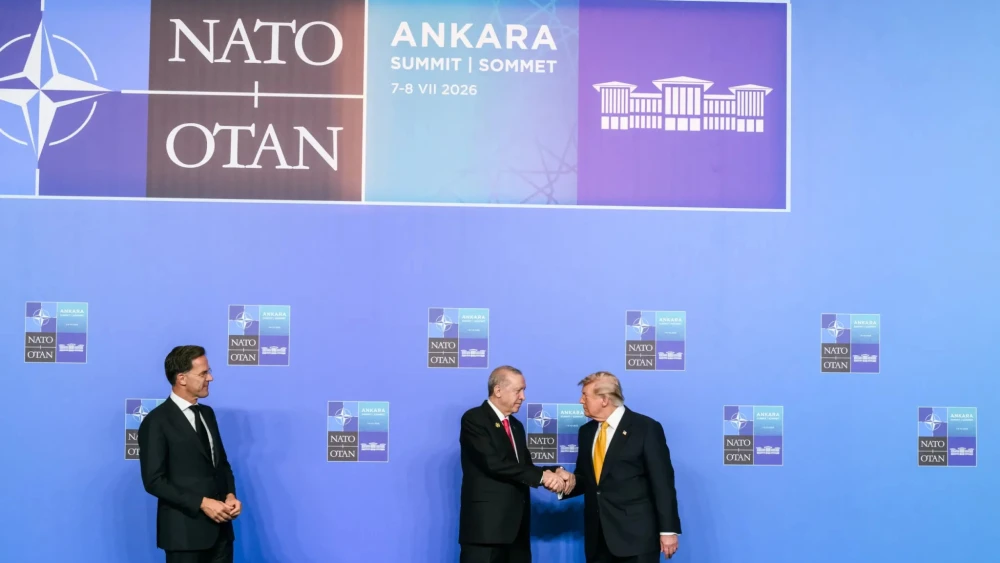
Does Erdoğan seriously believe that the Turkish flag will one day fly over the walls of Jerusalem’s Old City? I wouldn’t necessarily doubt his conviction. But the fact that a leading member of his government can publicly entertain such a prospect—at the same time that Ankara is treated in Washington and other Western capitals as a potentially constructive interlocutor in resolving the Israeli-Palestinian conflict—tells us that a culture of denial prevails in our understanding of Turkey’s neo-imperial aims.
There is no shortage of conferences, academic departments, political parties and nongovernmental organizations in the Western world devoted to the eradication of the vestiges of imperialism in the Middle East. But Turkey is seen as an indigenous exception.
It’s no longer enough to complain about the double standard here as regards Israel. With the decline of Iranian power, alongside Turkey’s close ties with Hamas, the threat is now tangible.
At present, of course, Turkey is in no position to begin a war against Israel. However, the warnings now being delivered by Western leaders concerning Israel’s emerging “pariah status,” most recently by U.S. President Donald Trump’s Mideast negotiator Jared Kushner, are a gift to Erdoğan.
It allows him to promote the fiction that Turkish power projection is in harmony with Western interests. And it permits him to push his imperial project with almost no costs attached, for the simple reason that no one is paying attention.