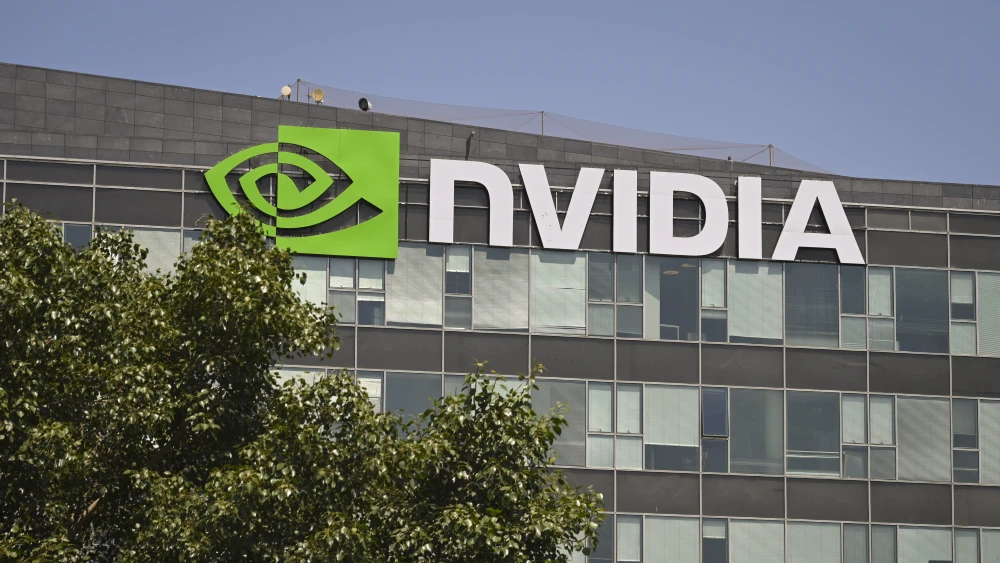

Nvidia announced Monday that its board had unanimously reinstated Jensen Huang as CEO, 11 days after announcing his resignation. While he was away, the company disclosed a figure that helps explain why the leadership turmoil was a talking point across Israel.
Nvidia’s global networking business, built around its acquisition of Israeli chipmaker Mellanox, generated more than $21 billion in a single quarter. As JNS reported last week, Israel’s real GDP grew at an 8% annualized rate in the third quarter, or 4% after excluding the adjustment for overseas production. Globes identified Nvidia as the main contributor to that adjustment, but the company’s precise contribution to Israeli GDP remains undisclosed.
Headlines that flooded social feeds and fueled office water cooler talk came amid a separate forecast that has the International Monetary Fund’s October outlook, which projects Israel will overtake Ireland and Sweden to become the world’s 25th-largest economy in 2026. It puts Israel’s GDP at about $747 billion this year and nearly $800 billion in 2027, measured in current U.S. dollars.
Engineers in Yokne’am are developing technology that connects processors in AI data centers around the world. Work done here illustrates how goods can be designed in Israel, manufactured and sold abroad, and still reach economic milestones despite years of war and mass protests abroad.
How technology made abroad enters Israel’s GDP
Nvidia alone doesn’t explain some of the impressive GDP figures credited to Israel’s economy. Nitzan Shechter, senior director of national accounts at Israel’s Central Bureau of Statistics, told JNS that the bureau makes an adjustment for goods manufactured by subcontractors or related companies overseas and sold abroad that never pass Israel’s borders. The Bank of Israel said the category mainly captures sales of advanced technology products manufactured overseas using know-how developed in Israel.
“This type of production is particularly significant in Israel and is also highly concentrated among a relatively small number of companies,” Shechter told JNS. He added that fluctuations in their activity can “have a substantial impact on the overall GDP growth rate and may sometimes mask developments in domestic economic activity.”
How Israel and the world responded
Huang’s return prompted congratulations from Israeli leaders. Israeli Prime Minister Netanyahu called it “good news,” and Israeli President Herzog congratulated Huang, thanking him for the longstanding commitment to Israel and its tech sector.
The CEO had called Israel Nvidia’s “second home” when the company announced plans for a campus in Kiryat Tivon. Globes had reported that engineers at its existing operations in nearby Yokne’am had worried a successor might reconsider the company’s commitment to the country. But even as concerns have proven moot at home, they did not stop conspiracy theories bubbling abroad.
His departure prompted unsupported speculation about Israeli involvement. Media watchdog HonestReporting documented a post by podcaster Ian Carroll suggesting Israeli corporate espionage. On a recent episode of Piers Morgan Uncensored, The Young Turks founder Cenk Uygur claimed that all of Huang’s potential replacements were Israeli, though he acknowledged his claims were unfounded and it was not known who was behind what he described as a coordinated effort to “take out” Huang.
Overtaking Ireland and Sweden
Ireland led Israel by about $64 billion in 2025. The IMF now projects Israel will finish 2026 about $37 billion ahead of Ireland. The jump is enough to take the 25th place Ireland held last year, and precision with exchange rates is significant for countries like Sweden, which lost out to Israel by just $1.9 billion in the forecast.
The ranking is based on projected full-year GDP in current U.S. dollars, and Nvidia’s exact contribution to Israel’s projected rise in these rankings remains unknown, although clearly substantial.
Treading carefully in the years ahead
Israel’s domestic economy has also regained ground, to mixed results. Eran Yashiv, an economist at Tel Aviv University, told JNS that higher defense spending drove much of the growth during the war years, but private consumption and investment were weak. He warned that if the Nvidia numbers are excluded, he would remain “wary of nominal GDP comparisons.”
Real GDP on a per capita basis barely rose in 2023 and even fell 0.3% in 2024 before rebounding 2.1% in 2025. Yashiv said he would watch real GDP excluding overseas production to judge whether the recovery lasts, and warned Israel faces a future drop in world rankings if a momentum of proposed sanctions from Europe comes to pass.
The Bank of Israel said Monday that total output was 0.9% above its long-term trend and is holding its benchmark interest rate at 3.25%. Excluding overseas production by Israeli companies, output was still about 4% below trend. That is the measure Yashiv said he would watch to see whether the recovery at home lasts.
Nvidia’s planned campus in Kiryat Tivon is one sign of continued investment in Israeli engineering. Another came Monday, when Amazon announced an agreement to buy Israeli startup Decart’s AI optimization technology and bring its founders and engineering team aboard.
At home, household spending rose 1.6% and fixed investment increased 2.7% from the previous quarter, signs that the domestic recovery is making headway.