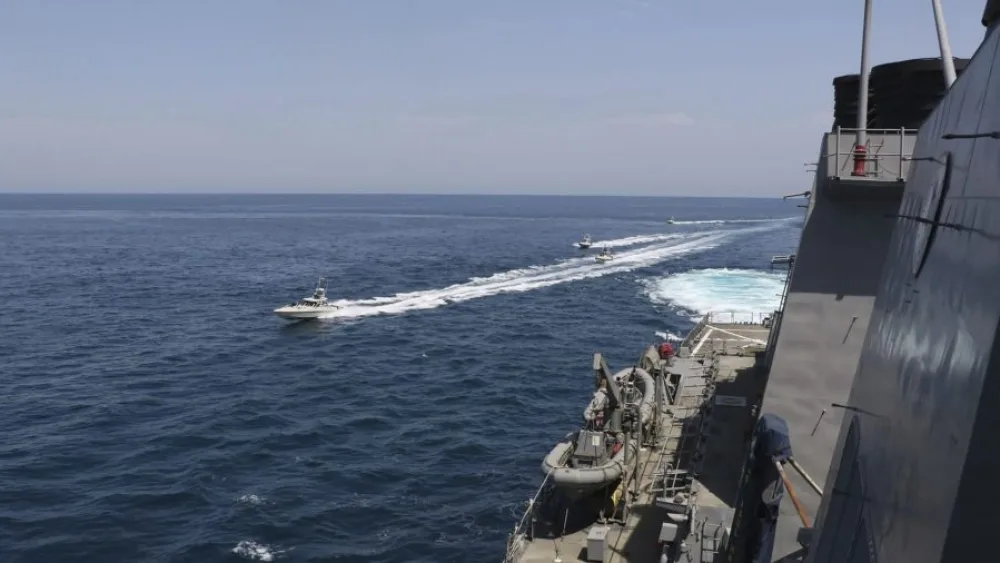
A dangerous incident occurred on April 15, 2020, between 11 fast-attack craft (FAC) of the Iranian Islamic Revolutionary Guard Corps Navy (IRGCN) and a number of American naval ships in the northern Persian Gulf near Bahrain. The Iranian vessels repeatedly crossed the bows and sterns of the U.S. vessels at extremely close range and high speeds, with one coming within 10 yards of a U.S. ship.
These actions, which were in blatant violation of the International Regulations for Preventing Collisions at Sea (COLREGS) and other international agreements relating to the security of vessels, were aimed at testing the readiness and response of the American naval forces. In response, the U.S. vessels practiced their combat doctrine for dealing with swarming attacks by Iranian FAC, which can be manned or can serve as unmanned bomb boats. Some of them are equipped with rockets.
The incident occurred after a relatively long period in which the Iranians abstained from provoking American naval forces operating in the area, after the United States issued stern warnings to Iran against such incidents, and appears to be a sign that Tehran is prepared to escalate its hostile actions against the United States and its allies.
In the vital Strait of Hormuz on March 27, two boats approached a U.S.-flagged container ship, while IRGC FAC approached a ship on April 2. On April 13, armed men boarded the Hong Kong-flagged SC Taipei bound for Saudi Arabia, near Iran’s Ras al-Kuh coast, holding the ship for a short time before releasing it. The IRGCN was probably responsible for the incident.
The IRGCN, with more than 20,000 servicemen, is considered one of the key forces defending Iran’s maritime borders. It has trained for years in asymmetrical warfare against U.S. forces, concentrating its efforts on fielding hundreds of FAC against the Americans, as well as commando attacks and ground-to-sea rocket attacks. It has also trained to lay mines against U.S. ships and its naval bases in the Gulf States.
The IRGCN, operating from a number of bases along the coast of the Persian Gulf, was also involved in attacks on Saudi oil tankers in May 2019. Their involvement was revealed by American intelligence, which photographed the Iranians as they placed mines on the tankers. Iranian media reported recently that Fajr-5 rocket batteries (333 mm, range 75 km) have been deployed along the Strait of Hormuz coastline.
IDF Lt.-Col. (ret.) Michael (Mickey) Segall, an expert on strategic issues with a focus on Iran, terrorism, and the Middle East, is a senior analyst at the Jerusalem Center for Public Affairs and at Alcyon Risk Advisors.
This article was first published by the Jerusalem Center for Public Affairs.