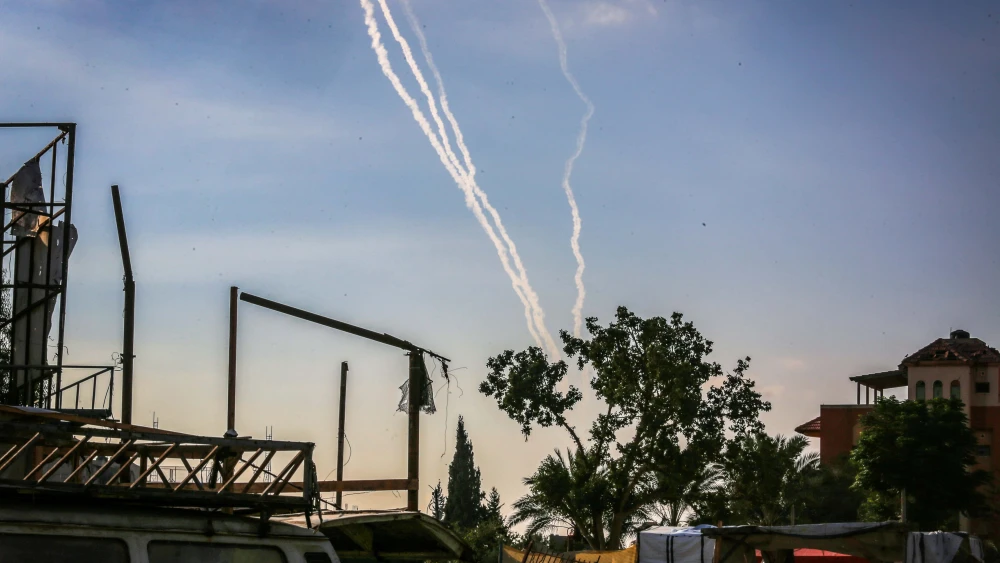
Fifteen months into its war with the Jewish state, Hamas is demonstrating continued capability to threaten Israeli territory, maintaining an almost daily pattern of rocket launches over the past 10 days despite significant degradation of its infrastructure in the Gaza Strip.
In the latest incident, on Saturday afternoon Israeli radar systems detected a rocket launch from northern Gaza that landed in the Erez region. This followed Friday’s dual launches—one impacting near Kibbutz Nir Am and another in an unpopulated area.
A separate significant development occurred on Friday, when Hamas attempted to target an Israeli helicopter with a man-portable air-defense system. The helicopter emerged unscathed, while the projectile—assessed to be headed toward the Be’eri region—was intercepted by Israel air defense systems.
Security analysts attribute Hamas’s persistent launch capability to several strategic factors. Israeli defense assessments indicate the organization retains a limited stockpile, ranging from dozens to several hundred rockets. With smuggling routes restricted primarily to the Philadelphi Corridor and Rafah crossing, each launch significantly depletes the terror group’s already diminished arsenal.
Defense officials have consistently maintained that completely eliminating Hamas’s rocket capability is an unrealistic objective.
The timing and intensity of recent launches potentially reflect multiple strategic considerations. Intelligence assessments suggest Hamas may be accelerating deployments to prevent stockpile seizures by advancing Israeli forces. Additionally, the increased activity could represent psychological pressure tactics ahead of potential hostage negotiations, exemplified by the terrorist organization’s recent release of footage showing captured IDF soldier Liri Albag.
A more concerning analysis suggests the possibility of operational recovery in areas where IDF presence has diminished. Despite severe disruption to Hamas’s command and control infrastructure, the absence of alternative governance structures may be enabling the terror organization to reconstitute certain capabilities.
Originally published by Israel Hayom.