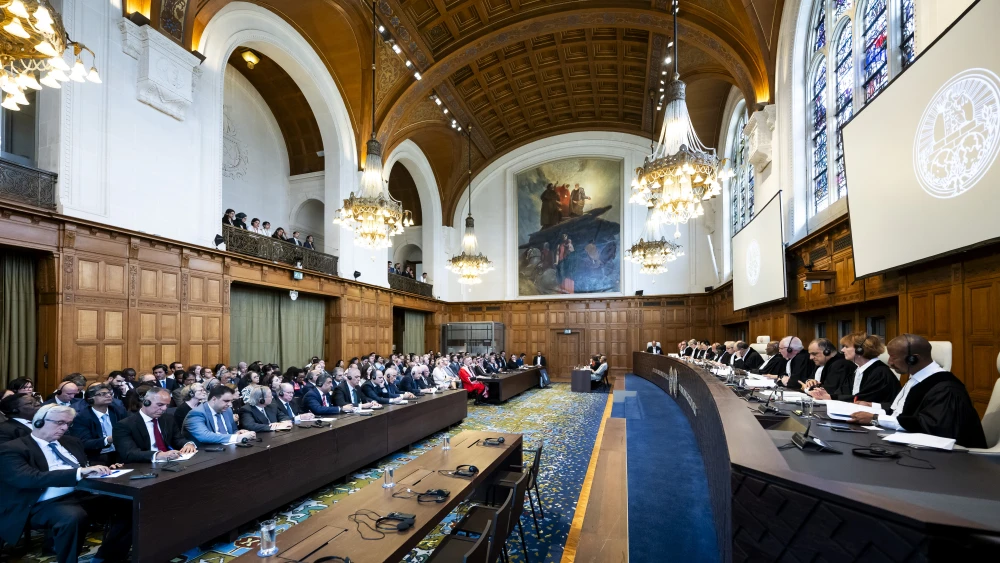

On Nov. 19, the International Court of Justice ruled, by a vote of 9-6, that Myanmar committed genocide against the Rohingya Muslims.
The Rohingya suffered terribly, and the generals who drove 700,000 people from their homes deserve every word of condemnation they receive.
But the ruling also did exactly what I warned of in September: It lowered the threshold for “genocidal intent,” in a case few people were watching, to craft a custom-built club that South Africa will now use to bludgeon Israel.
For decades, the court required that genocidal intent must be “the only reasonable inference” from the evidence. Even lesser atrocities such as ethnic cleansing, punishment and revenge were not genocide, much less self-defense, rescue of hostages or elimination of a genocidal threat.
Now the court’s definition of genocidal intent has been watered down badly enough to sink it. The court can weigh a “history of discrimination” and acts that “violate the foundations” of a group, and claim that a military response to an insurgency can still be “animated by genocidal intent.”
Under that standard, a country can, for example, be invaded, see 1,200 of its people murdered in a single day and 251 dragged off as hostages and still see the world’s highest court reject self-defense as a valid explanation. The “history of discrimination,” in Israel’s case, means libels such as “apartheid” and “occupation” repeated for years by the likes of Amnesty International, Human Rights Watch and former U.N. official Francesca Albanese.
The Malbim, the 19th-century commentator, explains that Haman built his case against the Jews in the book of Esther by combining half-truths into a single imagined threat.
A “holistic assessment” is the ICJ’s legal term for this. The six dissenting judges warned that the court’s new approach is “so indeterminate that it borders on arbitrariness,” but that, of course, is the point.
The Torah described this pattern long before there was a Hague. “Come, let us deal wisely with them,” said Pharaoh, “lest they multiply, and, if there will be a war, join with our enemies and fight against us” (Exodus 1:10).
As the Malbim points out, the threat was preposterous: only seventy souls had come down to Egypt, they had been loyal residents, one of them had saved the entire country from famine and no enemy army stood on the horizon. Nonetheless, in the name of national security, Pharaoh ordered that every newborn Jewish boy be thrown into the Nile.
In The Jew-Hatred Mindset, the scriptural guide on antisemitism that Rabbi Moshe B. Parnes and I wrote for the Coalition for Jewish Values, we identify this as a fixed belief of the antisemite: That the Jews are a threat so irrational and overarching that it justifies preemptive action of any kind.
Today’s version runs in reverse.
Pharaoh invented a threat to justify a real genocide. Israel faces a real threat, from an organization whose founding covenant calls for killing Jews and whose leaders promised after Oct. 7 to repeat that massacre “again and again.” Israel’s defense against that threat is now recast as an imaginary genocide.
When Jews are harmless, they are called a menace. When they defend themselves from a real menace, they are called murderers. Needless to say, no other people is held to such an obscene “standard.”
To a rational mind, a population that grows from roughly 1.4 million to more than 2.1 million, as Gaza’s did in the 16 years since Hamas seized power, is not suffering a genocide. When nearly 50% of a population is under 18, it is not suffering a genocide. Israel’s accusers know this, which is precisely why the definition of genocide had to be changed.
The Talmud (Kiddushin 70b) offers a principle that psychology later rediscovered as “projection”: kol haposel, b’mumo posel, “one who disqualifies others does so with his own defect.” The genocide in this story was announced in Hamas’s own words, and those who march on its behalf accuse Israel of the very crime they hope to see committed against Jews.
Nor will this new standard stay in the Middle East. A test under which fighting an insurgency counts as evidence of intent and a record of grievances counts as proof can be turned against the United States for Fallujah and Mosul, against Britain or against any Western army ever forced to fight an enemy hiding among civilians.
Those who cheer the decision today on account of Israel should consider whose soldiers come next.
Raphael Lemkin coined the word “genocide” in 1944 to name what was being done to his own family, 49 of whom were murdered. A court that stretches his word until it fits the self-defense of the Jewish people will make the next real genocide harder to name, and the next Pharaoh—or the next Hitler—easier to excuse.