Newsletter
Newsletter Support JNS

‘Tammuz Crab’

The crab’s pinch characterizes the pain the Jewish people endured in Tammuz, a month with no festivals yet a fast day.

Mark Podwal Tammuz crab
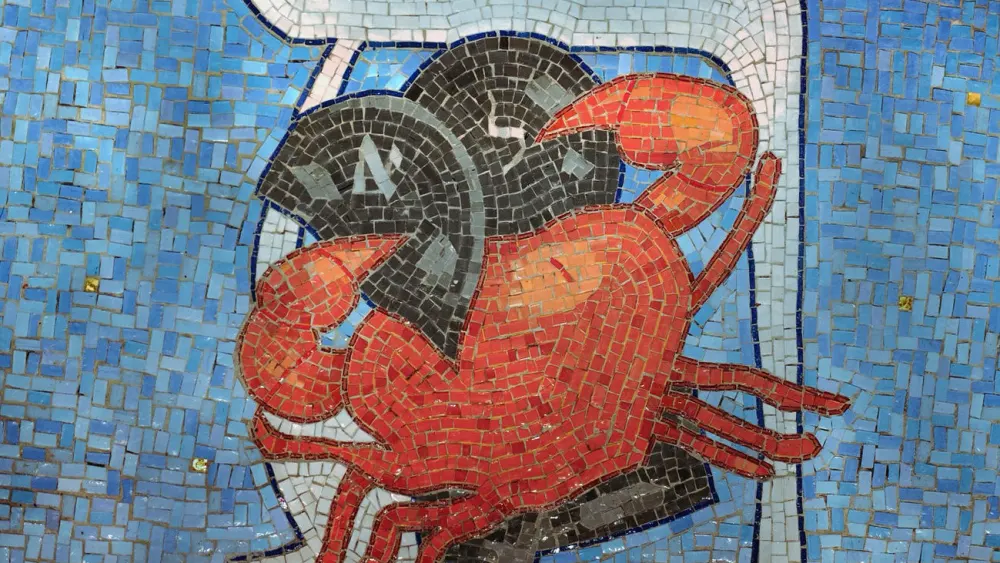
A crab mosaic for the Jewish month of Tammuz, which Mark Podwal designed for the floor of the Museum at Eldridge Street, housed in Manhattan’s Eldridge Street Synagogue. Credit: Mark Podwal.
Mark Podwal is an artist in New York. He has illustrated many of the books of his friend Elie Wiesel, and his work can be found in major museums, Jewish and non-Jewish, worldwide.
Mark Podwal Tammuz crab
A crab mosaic for the Jewish month of Tammuz, which Mark Podwal designed for the floor of the Museum at Eldridge Street, housed in Manhattan’s Eldridge Street Synagogue. Credit: Mark Podwal.

A crab is the Zodiac sign for the Jewish month of Tammuz, during which a fast falls on the 17th day. Though the crab is weak, its pinch is excruciatingly painful.

The crab’s pinch characterizes the pain the Jewish people endured in Tammuz, a month with no festivals yet a fast day.

Legend says that the first of Tammuz was the day that Adam and Eve were expelled from the Garden of Eden.

A Midrash adds that the first of Tammuz was the day that Moses—whom God instructed to speak to a rock in order for it to yield water to quench the thirst of the Israelites—sinned by striking the stone instead.

As a punishment for not speaking to the rock, God forbade Moses from entering the Promised Land.

Among the five tragic events that tradition holds took place on the 17th of Tammuz was the shattering of the tablets of the Ten Commandments.

To memorialize these events, the 17th of Tammuz is observed as a minor fast day and marks the beginning of a three-week period of mourning that lasts until Tisha B’Av, the fast day that commemorates the destruction of both Jewish Temples.

This image of a crab holding the shattered Ten Commandments is from a mosaic I designed for the Museum at Eldridge Street, which is housed in the Eldridge Street Synagogue on Manhattan’s Lower East Side.

The Israeli premier invoked Passover’s Ten Plagues, citing “ten blows” against Iran and “ten achievements,” including Israel’s unprecedented coordination with the United States.
One girl was severely injured in the four volleys that targeted the country’s most populated area hours before a major holiday.
The New York City mayor, who is a harsh and frequent critic of Israel, also wove his plans on affordability and to fight U.S. immigration policy into his telling of the holiday story.
The defense minister said residents of Southern Lebanon would be barred from returning “until the safety and security of northern Israeli residents is ensured.”
Limor Son Har-Melech, who introduced the bill and whose husband was murdered in a 2003 terror attack, stated that the “historic law” means “whoever chooses to murder Jews because they are Jews forfeits their right to live.”
The Jewish Electorate Institute poll largely conforms with surveys of the general U.S. public, which have found that most Americans oppose the war against Iran, with sharp partisan divisions between Republicans and Democrats.