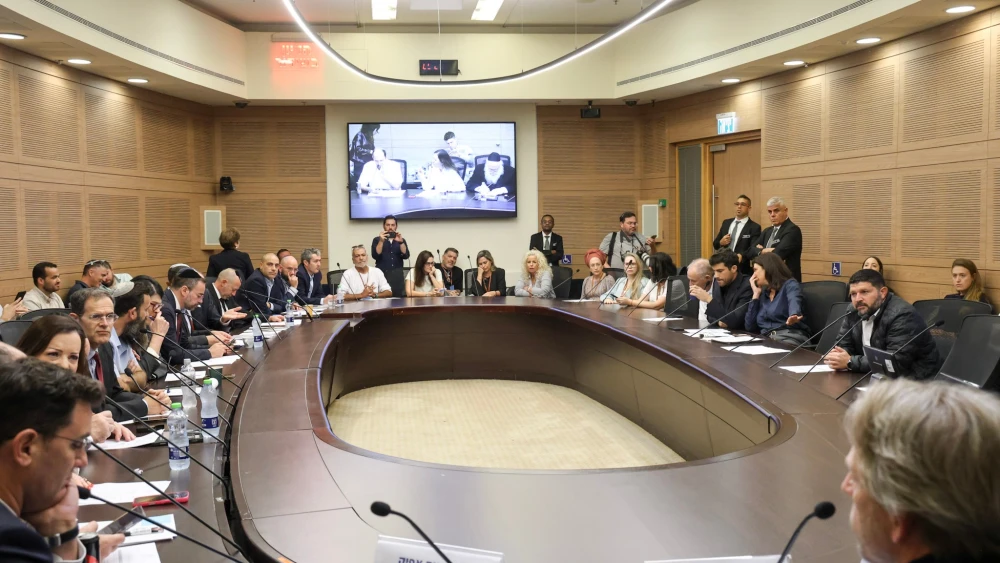

Israel’s opposition has set up several special committees in the parliament to repeal laws passed by the Netanyahu government in the previous Knesset. While it has the right to do so, there are questions whether it has the mandate to do so. It hasn’t yet formed a government.
The special committees announced last week and early this week intend to repeal “regime coup” laws, the opposition’s term for judicial reform legislation. This includes reversing changes made to the judicial selection process and restoring the wording of Basic Law: The Judiciary to its form before the government’s amendments.
A separate committee has also been created to repeal laws that limited the attorney general’s powers and split them into separate positions.
Other committees concern the cancellation of the recently passed Communications (Broadcasting) Law, 2026, meant to free up Israel’s communications market, and the Police Ordinance (Amendment No. 45) Law, 2026, which restructures the Police Internal Investigations Department as an independent body within the Justice Ministry, separate from the State Attorney’s Office. In both cases, the opposition said the changes invited political interference.
Another special committee deals with legislation concerning term limits for the prime minister and when an Israeli leader can be considered “incapacitated,” or incapable of filling his role, something that potentially touches on Benjamin Netanyahu’s continued tenure.
MK Simcha Rothman of the Religious Zionist party, who until recently served as chairman of the Knesset’s Constitution, Law and Justice Committee, told JNS that the opposition’s actions are “unprecedented.”
“In the past, as governments were in the process of being formed, laws were passed during the interim period, but through existing committees, not special committees,” he said. “The Knesset is working in a waiting period. Generally, there is no instance when a person is a member of five separate committees during this time. This is not something for which I have found precedent.”

The Knesset legal adviser, attorney Sagit Afik, in an announcement about the special committees, said there was nothing improper in their formation. “In order to establish permanent committees, a coalition is required and we are not there [yet]; therefore, during this period special committees can be established and there is no flaw in the legislative process.”
Ilana Shpaizman, a senior lecturer at the Department of Political Studies at Bar-Ilan University in Ramat Gan, agreed, arguing that the criticism of the opposition’s actions is overblown. She told JNS that there is an urgency to establish the committees before the Netanyahu-era laws go into effect. “All these laws start either from this Knesset, or from Jan. 1, and therefore it’s urgent to cancel them before they become active,” she said. “You cannot legislate changes to the rules of the game as the game is going on.”
However, not only is the opposition making changes without a government, it is doing so without a Jewish majority, holding only 48 Knesset seats to the coalition’s 53, forcing it to rely on the vote of anti-Zionist Arab parties. Those two parties, the Joint List and Ra’am (United Arab List), hold 19 seats, giving the opposition a comfortable cushion in the 120-seat Knesset. Shpaizman said the nature of the Arab parties is a non-issue.
Amihood Amir, chairman of Professors for a Strong Israel, an academic group focused on national security and policy, disagreed with Shpaizman’s analysis. He pointed to the decision of the Central Elections Committee on Sept. 23 to ban the Arab parties. The Supreme Court overturned that decision on Oct. 2, citing insufficient evidence.
Amir said it was the Central Elections Committee that followed the letter of the law, which prevents entities that do not support a Jewish state from participating in the Knesset. “These Arab parties clearly do not want a Jewish country. They march out of the Knesset during the playing of the national anthem. ... So it’s not correct to say that every person has a vote, because legally these guys shouldn’t get voted in. The only reason they did is because of a reactionary Bolshevik judiciary that allowed it.”
The opposition is breaking a campaign promise because it said it would not work with anti-Zionist parties, and now it is “planning to make laws without being able to form a government,” he said. While it is true that special committees have been set up during interim periods in the past, it was clear that a government would be formed. “You knew that there was a majority of people who wanted something done,” he said.
“Legally, they can overturn laws, but does that mean it’s ethical?” Amir asked. One of the opposition’s arguments against the previous government’s judicial reform plan was that it lacked a broad national consensus. “Do they have a broad national consensus now? They can’t even form a government. What we’re in fact seeing is that everything they accused the right-wing of doing, they are actually doing.”
One of the ironies is that the opposition parties call themselves the “change parties,” but what they really want is to keep the status quo, he said. They’re trying to restore everything to the way it was before the Netanyahu government’s reforms. Before that, the opposition enjoyed a lop-sided advantage over the right-wing camp. It was five-to-one. There were the opposition parties themselves and their allies: the Supreme Court, the bureaucracy, the media, and academia.
“What you have is a minority that is attempting to control a majority,” Amir said. “They can do it for a while. But at some point, things erupt. And they are now sitting on top of a volcano. They’re trying to contain it because the majority of people are not with them.”