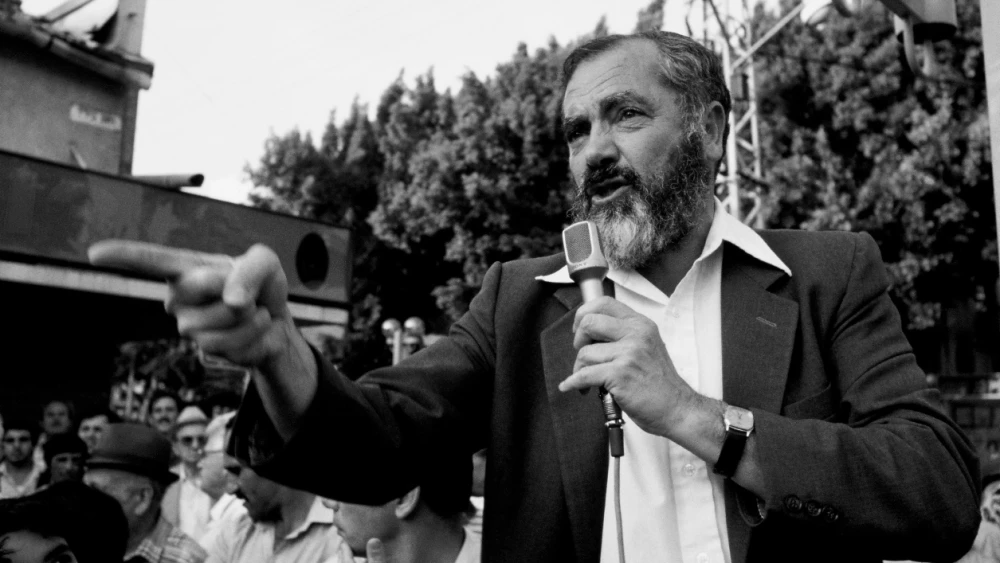

In Israeli politics, “Kahanist” has become an accusation so easy to make that the person making it hardly has to explain what he means.
Is he talking about Rabbi Meir Kahane’s reading of Jewish law, his proposal to remove Arabs from Israel or his warning that movements committed to Israel’s destruction would use any opportunity to pursue it?
These are different claims.
I knew Kahane in the early days of the Jewish Defense League, when he asked me to train young Jews in self-defense. I understand the appeal of a man who insisted that Jews take responsibility for their own safety. I also think his arguments deserve the scrutiny that comes with taking him seriously.
Kahane understood Jewish sovereignty as a religious obligation.
In The Jewish Idea, he drew on biblical and rabbinic sources to argue that the Jewish people’s relationship with the Land of Israel entailed duties that a Jewish government had to uphold. His program grew from that conviction.
Critics who call Kahane a racist should be prepared to identify the argument or policy they condemn. If they object to recognizing a particular covenant between the Jewish people and the Land of Israel as inherently racist, then their objection extends to the Torah itself.
That is a much broader claim, and it ought to be stated plainly.
The harder question is how to apply ancient sources to the citizens of a modern state. Maimonides, in his Mishneh Torah’s “Laws of Kings and Wars,” requires an offer of peace even before an obligatory war, while placing conditions on the peace he describes.
Leviticus 19:34 commands love for the ger who dwells among the Israelites and grounds that duty in the Jewish experience of being strangers in Egypt.
What those texts require today is a matter of interpretation. A reader can affirm the Torah’s particular obligations to the Jewish people and still ask how Kahane got from those obligations to his Kach Party’s call to remove Arab citizens from Israel.
The step from text to policy is what needs to be explained.
Kahane won a single Knesset seat in 1984 and served through the end of his term. In 1985, the Knesset amended its Basic Law to include incitement to racism as grounds for electoral disqualification. In 1988, Israel’s Central Elections Committee barred Kach from the next election, and the Supreme Court unanimously upheld the decision.
That sequence matters. Kahane kept his seat for the term voters had elected him to serve. The authorities prevented his party from contesting the next election.
Were there additional factors leading to Kahane’s ban?
The Likud Party took steps to block Kach from running, and contemporary reporting identified the party—then led by Yitzhak Shamir—as the likely chief beneficiary of the ban. The fear that Kahane could siphon votes from Likud was therefore a plausible political motive, especially in a close race.
The public record establishes Likud’s involvement and its incentive. How much weight Shamir personally gave that calculation remains harder to establish. A fair account should give readers both the legal grounds for the decision and the politics surrounding it. Kahane bashers fail to discuss such issues.
Liberal voices too eager for peace with Arabs at any cost give Arabs hope that Jewish resolve might crumble.
I marvel at liberal voices that invoke free speech when neo-Nazis want to march and then look for ways to silence Kahane.
In 1977, the American Civil Liberties Union defended the right of neo-Nazis to demonstrate in Skokie, Illinois, a community that was home to hundreds of Holocaust survivors.
Imagine what it meant for Jews who had survived Hitler to see men asking to parade through their town in Nazi uniforms and swastikas. The ACLU’s lawyers understood the offense and defended the right to demonstrate anyway. They believed that a civil liberty had to extend even to people whose views they found abhorrent.
Apply that principle to Kahane. Israel’s decision to keep Kach off the ballot in 1988 raises a question about eligibility to stand for election. Kahane’s right to state his views in public raises a separate question. The same distinction applies to speech and incitement.
American law draws a line at advocacy intended and likely to produce imminent lawless action. Within those limits, anyone who believes freedom of speech protects even the public expression of Nazi ideology should be willing to defend Kahane’s right to speak and then challenge him openly, point by point.
In my view, the strongest reason Kahane’s warnings have regained an audience is the conduct of Arab movements that still seek Israel’s destruction, above all Hamas.
The riots of May 2021 brought communal violence into mixed cities such as Lod and Acre and put public safety at the center of Otzma Yehudit leader Itamar Ben-Gvir’s campaign. In 2022, the joint list that included Ben-Gvir’s party won 14 seats. Voter movement from the former Yamina camp and the electoral alliance itself helped produce that result.
This breakthrough came before Oct. 7, 2023. The Hamas-led massacre and hostage-taking gave Israelis a further reason to revisit warnings about what an armed movement could do if it breached Israel’s defenses.
Kahane warned that Arabs would never abandon the goal of eliminating Israel. The record supports a more precise and, to my mind, more consequential warning.
An organization can state immediate practical reasons to observe a period of calm, advocating peace while retaining its long-term objectives of Israel’s destruction. Israel must judge such a movement by its aims, preparations and conduct.
Oct. 7 showed the cost of misjudging Hamas. The PLO’s formal recognition of Israel in 1993, when weighed against their public policy of “pay for slay” for the murder of Israelis, serves as a similar warning.
In 1923, Revisionist Zionist leader Ze’ev Jabotinsky argued that Palestinian Arabs had national aspirations of their own and would resist Zionism so long as they believed they could defeat it. He took that opposition seriously.
His answer was an “iron wall”: defensive strength that would convince opponents the Jewish national project could be neither prevented nor destroyed.
This is where Kahane’s warning comes closest to Jabotinsky’s. Both doubted that assurances could overcome a determined adversary’s belief that it still had a chance to prevail.
Liberal voices too eager for peace with Arabs at any cost give Arabs hope that Jewish resolve might crumble. This may explain why some Arab voices preach peace with Israel in English while calling for jihad in Arabic. Arabs recognize this double talk as taqiyah.
Jabotinsky also described what he expected once the wall held: Those who pledged to defeat Zionism would lose influence, while leaders prepared to negotiate would gain it. He explicitly promised equal rights and rejected expulsion. Kahane called for the expulsion of Arabs from Israel, in a departure from Jabotinsky.
For Jabotinsky, Jewish strength would make a future bargain possible. But his theory failed on Oct. 7: Despite Israel’s overall strength and its constant payments to Hamas in an effort to buy peace, Israel failed to deter the group from carrying out its murderous attack.
While Kahane’s call to expel Arabs was not received favorably in the 1980s and may have contributed to the charge of racism, more Israelis have come around to this policy post-Oct. 7. Hence, the rise of Kahanism.
The next time someone calls an Israeli a Kahanist for insisting that Israel take its enemies at their word, I would ask what, exactly, they dispute. Is it Hamas’s intentions, the need for Israeli deterrence or a specific policy Kahane proposed?
Each question deserves its own answer. Israel can learn from Kahane’s warning that determined enemies should be judged by their deeds, not their soothing words.