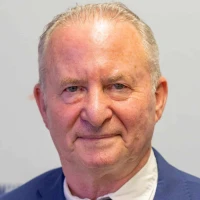
Rabbi Donniel Hartman, president of the Shalom Hartman Institute in Jerusalem, on Tuesday night urged Jews worldwide to reject pessimism in the face of rising antisemitism and called on Israel’s political leaders to rise above partisan divisions.
“My message is: Don’t give up. Don’t succumb to pessimism,” Hartman told JNS in an interview at the opening of JCC Global’s 11th World Conference of JCCs in Jerusalem, attended by more than 300 delegates from some 30 countries.
Hartman encouraged Jewish communities to strengthen their identity and sense of purpose rather than allow external threats to define them.
“We can, at times of crisis, shut down. And when we shut down and gather the wagons around, we’re going to disconnect ourselves from our source of life,” he said. “And that source of life is ideas, hope and inspiration.”
Asked whether he remained optimistic about the Jewish future, Hartman responded: “Of course I’m hopeful. Jews would have never survived if we weren’t hopeful.”
He pointed to the Jewish people’s resilience throughout history, from the destruction of the Second Temple to the Holocaust, as evidence of their ability to overcome adversity.
Turning to Israel’s current political challenges, Hartman urged the country’s leaders to balance security concerns with the Jewish state’s moral and national aspirations.
“One of the great challenges we face is: How do we not let our concern for security dominate and override our concern for our mission and our values?” he said. “Values and security aren’t in conflict. They have to merge together.”
“Right now, our leaders are reaching for the lowest common denominator. That’s what you have to do in an election. The election’s over now. Reach higher. The Jewish people will follow. Don’t worry.”
A home for every Jew
Delivering the keynote address at the opening of the three-day conference, Hartman spoke of his longstanding connection to the JCC movement and its influence on his philosophy of Jewish pluralism.
“I didn’t just work at the JCC; I was formed in the JCC,” he told the gathering. “It was through 11 years working as a scholar in residence at the JCC on the Palisades [in New Jersey] that pluralism became the mission of my life.”
He warned against defining Jewish belonging through rigid ideological boundaries.
“We have to stop talking about who’s a good Jew, who’s a better Jew and who’s a bad Jew; who’s a good Zionist, who’s a bad Zionist and who’s a better Zionist,” he said.
“At moments like these, we need big tents,” he added, urging JCCs to welcome Jews of different backgrounds and political perspectives.
Hartman cautioned against viewing every criticism of Israel through the prism of antisemitism, arguing that doing so risks alienating potential allies.
“We have allies around the world who we know are not antisemites. And when you use the language of antisemitism on them, you lose them,” he said.
Without downplaying the importance of combating antisemitism, he warned against allowing it to define Jewish identity.
“Our kids aren’t going to stay Jewish because our enemies want to kill us. They’re waiting for something inspiring,” he said.
Hartman also defended the right of Diaspora Jews to criticize Israel and participate in shaping its future.
“Fight for the Israel you want. Don’t let anybody in the world say, because you don’t live here, you don’t have a voice,” he said.
Quoting his late father, Rabbi David Hartman, the founder of the Shalom Hartman Institute, he added: “Israel is too important to leave to Israelis.”
‘Rooted Here, Transforming Everywhere’
The conference, held under the theme “Rooted Here, Transforming Everywhere,” brought together Jewish community leaders from around the world to discuss the future of Jewish life and strengthen international partnerships.
Smadar Bar-Akiva, executive director of JCC Global since 2002, reflected on the organization’s mission of connecting Jewish communities across borders. Founded in Jerusalem in 1977, JCC Global connects more than 1,000 Jewish Community Centers worldwide, serving approximately 3.5 million people annually.
Bar-Akiva highlighted cooperation among 32 JCCs in eight countries and support for 11 Jewish community centers in Ukraine, with programs reaching more than 6,000 people.
Drawing on the imagery of trees, Bar-Akiva contrasted the pine tree in Israeli poet Leah Goldberg’s famous poem, symbolizing attachment to two homelands, with the olive tree, rooted in the land but dependent on cross-pollination to flourish.
“The olive tree is homegrown, yet it needs pollen from a different variety to set fruit,” Bar-Akiva said. “It turns out that even olive trees need global partnerships.”
She drew a parallel with Jewish communities in Israel and abroad, arguing that their different experiences enrich Jewish life.
“Our roots may be planted here, but without the richness of Jews all over the world, we could not blossom,” she said.
‘30 countries, one network’
Lisie Gottdenker, chair of the board of directors of the JCC Association of North America for the 2026–2028 term and vice president of JCC Global, welcomed delegates to Jerusalem.
“It has been a long road to this room—a pandemic that closed our doors, wars that tested our communities, years in which we met on screens in small squares,” she said.
Gottdenker noted the diversity of the gathering, with participants from Europe, the former Soviet Union, Latin America, North America, Australia, India and Israel.
“Thirty countries, one network,” she declared.
Gottdenker noted that the conference was dedicated to the memory of JCC Global’s immediate past president, Sheila Lambert, who died in December 2025 at the age of 78.
She described Lambert as an exceptional Jewish leader who worked tirelessly to bring organizations together and strengthen Jewish unity. Jerusalem, she noted, held a special place in Lambert’s heart, and she had supported several nonprofit organizations in the city.
A JCC that refused to close
Inessa Nosenko, executive director of the Mazal Tov JCC in Zaporizhzhia, Ukraine, described how her community has persevered despite the war.
Nosenko, who also serves as a vice chair of JCC Global representing Ukraine, recalled April 16, 2026, when a drone struck just outside the center while children, staff and volunteers were inside.
The explosion shattered windows and damaged rooms, but those sheltering in the building survived. Community members subsequently repaired the damage, cleared debris and planted flowers.
“Since the beginning of the war on Feb. 24, 2022, we have not closed for one day,” she told the gathering. “A JCC is not just a building. It is not just the walls. A JCC is something more.”
Nosenko thanked JCC Global’s international partners, including Jewish community centers in California and Argentina, for helping sustain the community.
“You sent your phone calls. You sent your visits. You sent the main message that we are not forgotten. We are not alone,” she said.
Another example of international Jewish solidarity, she noted, is Migdal JCC, based in Odesa, which has organized retreats for Jewish families seeking respite from the war.
In August 2025, Migdal held its “Halom 28” retreat in Pidgirya, western Ukraine, offering families a break from rocket and drone attacks while strengthening their connection to Israel through educational activities, Jewish traditions and Shabbat celebrations.
Supported by JCC Global, the Mosaic Fund and other donors, the program provided participants with a rare opportunity to experience peace and normalcy amid the war.

‘We don’t break’
Concluding his keynote address, Hartman drew on the story of Chanukah, describing the upcoming holiday as a celebration not only of light but of Jewish heroism and resilience.
“The story of the Jewish people for 3,000 years is not just a story of light. It’s a story of a people who never broke,” he said. “We didn’t want 2026 to be the way it is. We deserve easier and better. But we don’t break.”
“The story of the Jewish people is not in the hands of others. The story of the Jewish people is in our hands.”