


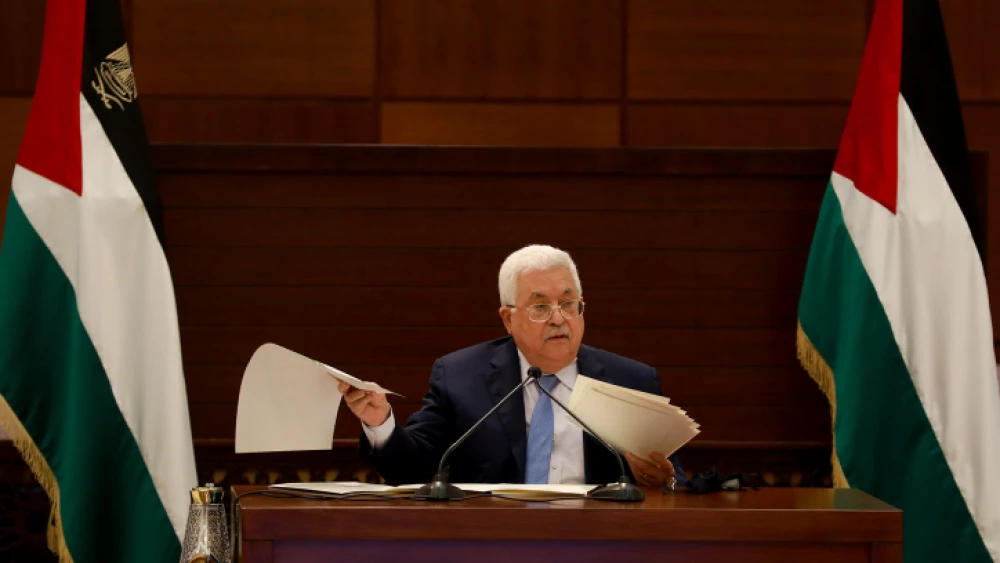

Last week’s meeting between Israeli Defense Minister Benny Gantz and Palestinian Authority leader Mahmoud Abbas drew harsh criticism both in Israel and from the Palestinian public. But it seems like the criticism actually benefited Abbas, and possibly his host as well, since it lent them both some relevance—if not on the ground, then at least in the media.
However, bringing Abbas back from the dead does not change the reality: The P.A. lacks the ability to govern or influence, and apparently any real support from the Palestinians, as well. In any case, it cannot and apparently has no desire to serve as a real partner for Israel in finding a solution that would end the Israeli-Palestinian conflict.
This year marks the 100th anniversary of the British Mandate. The establishment of the Mandate cut off the Arabs of what would become Israel from their brothers in the Arab world, thereby serving as a starting point—ground zero—for the growth of a national Palestinian movement, that sought to take the Land of Israel for itself. Anyone who had previously seen himself as an Arab or a Syrian now became a “Palestinian,” thanks to the haphazardness of the British.
But 100 years on, the Palestinians find themselves going back to where they started, after their campaign to build a nation and found a state ended in a crashing failure. At this rate, 2022 could wind up becoming the year that buries the what little remains of idea of Palestinian nationalism.
This failure is to a large extent the doing of the Palestinians themselves, who throughout the years have refused any compromise and stuck to the idea of “the whole Palestine,” which includes no room for a Jewish state. Ironically, it is Israeli governments—and the current one is no different from its predecessors—that continue to breath life into the Palestinian dream, mostly due to tactical political considerations and a desire to avoid making difficult decisions.
This is the situation in Judea and Samaria, where Israel sponsors the P.A. and works to strengthen it in the vain hope that it will function as a kind of municipal government with extra authorities, that takes charge of trash collection and provides healthcare and educational services to the residents. The first to call this bluff are, of course, the Palestinians themselves, who are sick of P.A. rule and who have also given up on the idea of Palestinian independence. Most of them appear to be willing to accept Israeli citizenship.
The same goes for the Gaza Strip, which is gradually becoming an alternative homeland for the Palestinians, also because of Israel’s decisions and actions. In 2005, it was Israel that decided to disengage from Gaza, and in the past few years Hamas has shored up its control there. Now the gestures and concessions Israel makes are met with threats and incitement and even rocket fire, which have shelved the false hope that Hamas can be tamed and turned into an upgraded P.A. that exists in partial independence and in return keeps things quiet along the border.
But just as happened in Judea and Samaria, the moment might come when Israel will have to re-enter Gaza and effectively retake control, certainly military control. That will be the final nail in the coffin of the idea of Palestinian independence and a Palestinian homeland.
Eyal Zisser is a lecturer in the Middle East History Department at Tel Aviv University.
This article first appeared in Israel Hayom.


