
Israelis were offered a preview, more like a spectacle, of what Israeli Prime Minister Benjamin Netanyahu and his coalition members have cautioned would happen if Arab parties were brought into the government.
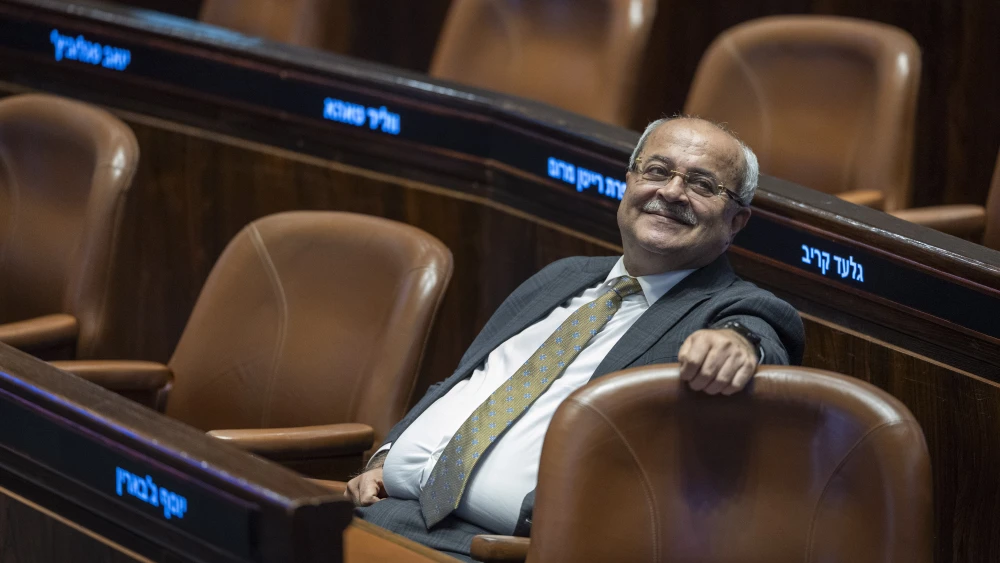
On Nov. 18, Ahmad Tibi of the Joint List, an alliance of Arab parties, sitting as deputy speaker of the legislature, threw out of the Knesset hall one MK after another when they accused him of supporting terror.
Likud MK Ofir Katz, along with Almog Cohen and Hanamel Dorfman of the Otzma Yehudit party, was evicted from the hall by Knesset guards on Tibi’s orders.
Amid the shouting, Tibi, to justify evicting the MKs, declared, “Anyone who says, ‘terror supporter’ is in violation of the regulations.” Only there was no such regulation. The Knesset’s legal adviser later confirmed that Tibi didn’t have the authority to remove the MKs under the circumstances.
MK Simcha Rothman of the Religious Zionist party, who also accused Tibi of being a terror supporter from the Knesset podium, told JNS that he shouted at Tibi at the time that there was “no legitimacy to such a rule.” Rothman managed to avoid being ejected.
Nevertheless, Tibi yelled at the MKs to “get used to the new rules.”
Dorfman told Israel’s Channel 14 that not once during the incident did Tibi deny he was a terror supporter.
Tibi served as an adviser to Yasser Arafat, chairman of the Palestine Liberation Organization.
Netanyahu has warned in interviews, speeches and across social media of the existential danger to which the left-wing opposition exposes Israel by courting the Arab parties, whose representatives have shown that their loyalty lies with “Palestine” and not Israel. Their loyalty extends to supporting terrorism against the Jewish state, he said.
“A dangerous government must not be formed with the terror supporters of Ra’am and the Joint List,” Netanyahu implored on his X account on Nov. 14. He attached a Channel 14 news segment revealing that the same Arab Knesset members who walked out of the plenum hall when “Hatikvah,” Israel’s national anthem, was played during the swearing-in ceremony for Israel’s 26th Knesset on Nov. 10, stood for the Palestinian national anthem at a Palestinian Authority congress only a few months prior.
On Nov. 16, Netanyahu included a video of Israeli military veterans and bereaved families crying out against a government that would include anti-Zionist Arab MKs."The people of Israel, war wounded, and bereaved families—against a government with supporters of terrorism,” the prime minister wrote. Many more such posts have followed.
During the election campaign, Joint List MKs were repeatedly asked whether they would condemn Hamas. They refused. The first plank in the party’s platform calls for the establishment of a Palestinian state in Judea, Samaria and Gaza with the eastern part of Jerusalem as its capital and the “right of return” for Palestinian refugees and their descendants, something Israeli politicians from across the political spectrum agree would mean the end of the Jewish state. The United Arab List (Ra’am), the second Arab party in the Knesset, supports identical goals.
Neither the Joint List nor Ra’am responded to JNS requests for comment.
“The ideology of both parties is actually to destroy Israel,” Amit Halevi, a former Knesset member for Likud, told JNS. Within government, their most deleterious impact would be on Israel’s ability to defend itself, he said. “The situation is particularly acute now, when Israel is actively at war.
“Israel is not under a theoretical threat. We are under serious attack,” said Halevi, who until recently served on the Knesset’s Foreign Affairs and Defense Committee. “Israel’s enemies are everywhere and they are rebuilding their power. Under these circumstances, it’s impossible to depend on Ahmad Tibi,” he continued.
Tibi became one of nine provisional deputy speakers on Nov. 18, a day after Matan Kahana, a member of Gadi Eisenkot’s Yashar party, secured the position of speaker of the Knesset with the help of votes from the Arab MKs. The Knesset speaker, together with his deputies, forms the Knesset Presidium, a body that determines the legislative agenda.
“You can take over Sderot or Kibbutz Be’eri with a Toyota [a reference to the terrorist massacres of Oct. 7, 2023], or you can take over the parliament without firing a shot,” Halevi told JNS. “They’ve succeeded in making themselves part of the decision-making process.”
Martin Sherman, founder of the Israel Institute for Strategic Studies (IISS) and a member of the Israel Defense and Security Forum (IDSF), told JNS that defense is also his top concern. “You’re going to be hamstrung in the field of security. Can you imagine if you receive intelligence requiring preemptive action? Would you be able to act if your government is dependent on anti-Zionist Arab votes?”
Both Sherman and Halevi pointed to the experience with Ra’am when it entered the “change government” led by Yair Lapid of the Yesh Atid party and Naftali Bennett of the Yamina party in June 2021. It was the first time since the state’s establishment that an Arab party joined a government.
“The only large-scale military campaign that Lapid and Bennett were able to mount was after the Knesset dispersed and there was an interim government so they didn’t need the votes of the Arab party,” Sherman said. “Operation Breaking Dawn,” a three-day military campaign (Aug. 5-7, 2022) against Palestinian Islamic Jihad in the Gaza Strip, took place about five weeks after the government disbanded due to ideological disagreements that led to defections.
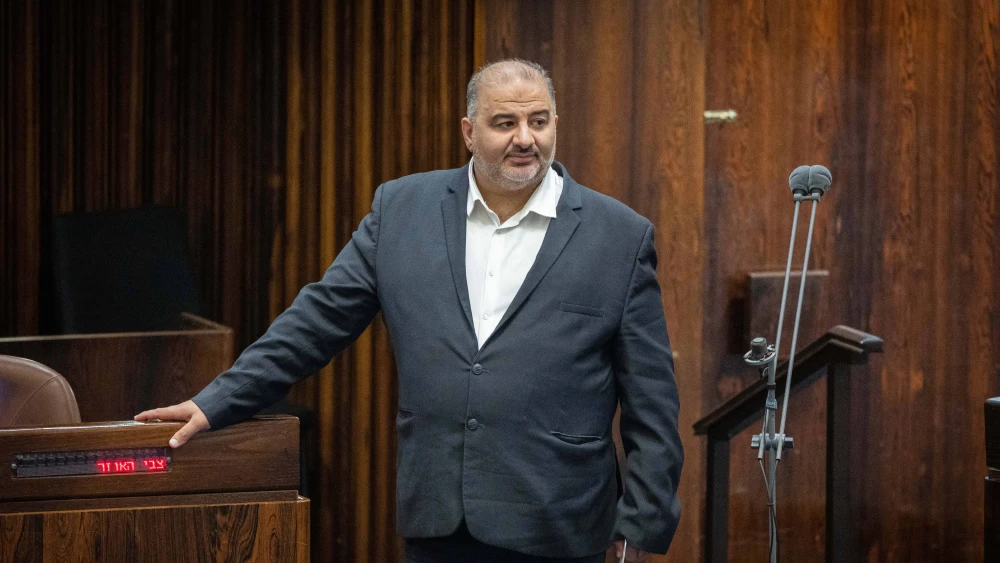
The change government couldn’t reforest the Negev because Ra’am leader Mansour Abbas opposed it, Halevi said. In January 2022, the Jewish National Fund (JNF/KKL-JNF) began planting trees on state land near Bedouin communities. The Bedouin viewed the planting as an attempt to evict them. They took to the streets, blocked roads and clashed with police. As the Bedouin of the Negev form an important part of Ra’am’s electoral base, the party threatened to stop supporting the government.
Avraham Duvdevani, then-chairman of KKL-JNF, told Israel’s Kan public broadcaster that his group wasn’t doing anything different from what it had been doing for years. The Jewish National Fund was founded in 1901 to purchase and develop land for Jewish settlement. “We have no idea what’s different now,” Duvdevani said. “This is part of the Zionist vision.”
What was different was that an Arab Islamist party was part of the Israeli government, Sherman said. Planting was temporarily halted.
Sherman also offered the example of Ghaida Rinawie Zoabi, an Arab MK from the Meretz party, who caused the government all kinds of headaches, prompting Lapid to offer her a post as Israeli consul in Shanghai. “She was unruly in the Knesset so in order to placate her, they offered her a plum job as a diplomat. You have this absurd situation where someone who was vehemently anti-Israel would represent Israel in the international theater,” Sherman said.
Ra’am and the Joint List shouldn’t be in the Knesset, Sherman argued. They were banned by the Central Elections Committee, which followed the letter of the law, a ban reversed by the Supreme Court, which ignored the law, he said.
The roots of the problem go deeper, Halevi said. An intellectual elite has for years influenced judges, officials, journalists and military officers. “There is a deep collaboration, a common foundation between the radical Islamic groups and these neo-Marxist groups—what we call the Red-Green alliance,” he said. “In Europe, it’s worse. Here we still have millions of Jews that, despite this indoctrination, have a strong identity and are ready to fight for their lives and for their nation.”