A Jewish organization in Canada appealed to the United Nations to intervene in a Belgian criminal case against two mohels, Jews who perform nonmedical circumcision of boys, the group said on Friday.
The Jewish Hasidic Council of Quebec (CJHQ) announced that it had sent an urgent appeal to Nazila Ghanea, the U.N. special rapporteur on freedom of religion or belief, asking her to examine whether Belgium’s treatment of brit milah, or ritual circumcision, violates religious freedom.
U.N. special rapporteurs have no authority to compel a country to change its laws, policies or administrative practices.
“The situation in Belgium is intolerable for thousands of Jewish parents who have been left completely in the dark about a sacred rite that affects the entire basis of their lives in the country,” Sam Muller, CJHQ’s executive director, wrote in a statement.
“The Belgian government is covertly seeking to criminalize Brit Milah, a practice that has been authorized in Belgium since the 19th Century,” he added. “A country that bans Brit Milah—or renders it impossible through a physician-only monopoly—forces the Jewish community to leave,” he added.
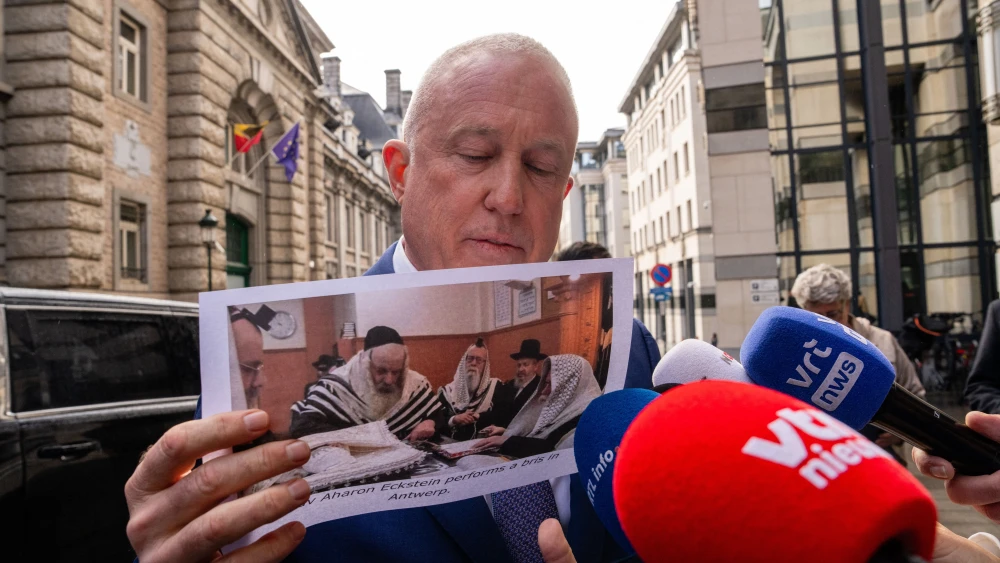
Belgian prosecutors in May decided to indict Jewish circumcisers for allegedly unlawfully conducting the Jewish ritual circumcision of boys, typically performed on eight-day-old infants.
Before the criminal investigation of the mohels, which began last year, brit milah was tolerated in Belgium, though it might violate the legal requirement that any surgery be performed by licensed medical staff.
The prosecution triggered a diplomatic crisis between Belgium and Israel and the United States, the latter two of which have vocally criticized the prosecution as antisemitic, amid other tensions with Belgium over its stance on military actions in Gaza and Lebanon, and the joint Israeli-U.S. operation in Iran. U.S. Ambassador to Belgium Bill White has repeatedly said the prosecution was antisemitic and asked authorities to drop it.
The mohels from Antwerp were first investigated due to complaints lodged against them by Moshe Aryeh Friedman, an anti-Zionist activist who has lobbied authorities to limit several Jewish customs, including the one that enables Haredi schools to separate girls and boys at state-recognized Jewish schools. The mainstream Jewish community of Antwerp, which is largely Haredi, shuns Friedman.
Belgian Foreign Minister Maxime Prévot claimed that the investigation was launched at the behest of representatives of the Belgian Jewish community. The Jewish Information and Documentation Center (JID) and other Jewish groups disputed this and declared Friedman to be a marginal voice without a following in the local Jewish population. White also publicly challenged Friedman’s claim to represent Belgian Jews.
Belgium is among several European countries that have outlawed shechita (the ritual slaughter of animals to make the meat kosher) and its Islamic counterpart, dhabihah or zabiha. These religious slaughter methods, which require animals to be conscious at the time of killing, are criticized by animal-rights advocates as inhumane.
A similar controversy is playing out over the nonmedical circumcision of boys. However, unlike slaughter without stunning, this practice has not been banned in any European country.
In 2012, a court in Cologne, Germany, briefly ruled against the practice, but the ruling was overridden through legislation amid an outcry over the decision.