
I was 14 the first time judo broke my heart.
My team had traveled to Buffalo for the American-Canadian Games, at the time one of the premier judo tournaments for young athletes. Even at that age, I had to make weight, and I had trained harder for that trip than for anything in my young life.
I made the weight. Then I stepped onto the mat for my first match, drained in a way I didn’t yet understand, against a boy about my weight but much taller.
It did not go well. He got a choke on me, and I was out. Whether he choked me out or I simply passed out, I honestly couldn’t tell you.
One match, and my tournament was over.
What I remember most, more than four decades later, is not the loss. It is that the boy who beat me stayed beside me until I was off the mat. He was 14 or 15 years old, and he already understood what the sport is for.
Today, I watch Israeli judoka offer their hands to opponents who refuse to take them, and I think of that boy.
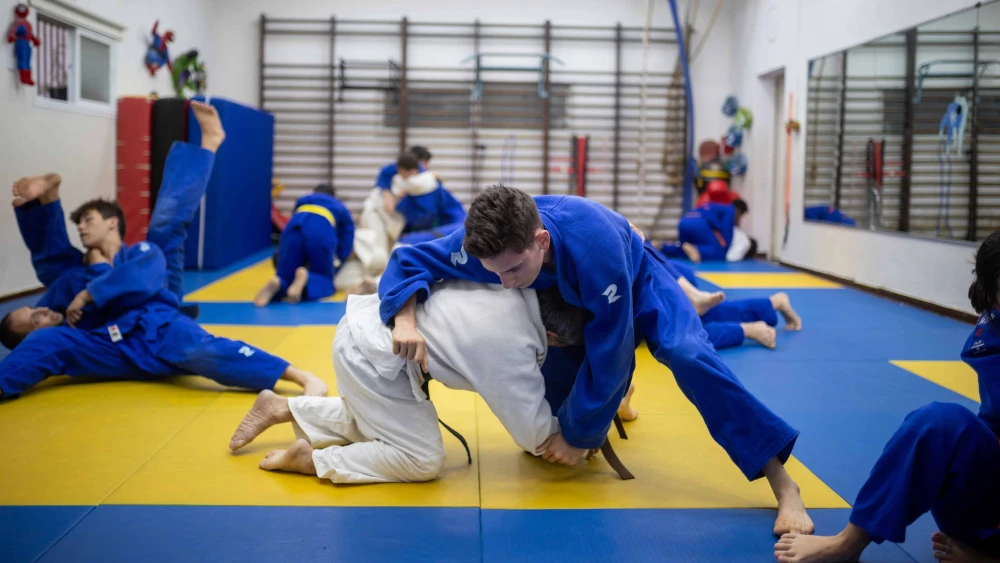
I started as a small kid in Queens, N.Y., too small for schoolyard sports. On the mat, size wasn’t everything. Balance, timing and leverage could beat it. Since then, I have competed, coached and refereed; judo has been the pillar of my life. I never once thought of it as political.
Every match begins and ends with a bow; the rules require it.
Jigoro Kano, who founded judo in Tokyo in 1882, built the sport on two principles: maximum efficiency and mutual welfare and benefit. Your partner lets you throw him so that you can improve, and you return the favor. The person across from you is not your enemy. He is the reason you get better.
The boy in Buffalo knew that, which is why it has been so painful to watch what happens when an Israeli steps onto the tatami.
Israel and judo were made for each other. Israel’s first Olympic medal ever was a judo silver, won by Yael Arad in Barcelona in 1992—20 years after the Munich Olympics massacre. She dedicated it to the families of the 11 Israeli athletes and coaches murdered in that attack. A day later, Oren Smadja added a bronze. Nearly half of all the Olympic medals Israel has won since have come in judo, a sport long ruled by Japan, France and Georgia.
I know something about being the small one on the mat. So does Israel.
In Paris in 2024—10 months after the Hamas-led terrorist attacks in southern Israel on Oct. 7, 2023—Israeli judoka won three medals. The coach in their corner was Smadja, weeks after burying his son Omer, a soldier killed in Gaza. I have stood in a coach’s corner more times than I can count. I cannot imagine standing in it carrying that.
That is one side of Israeli judo. The other side begins with a hand that stays down.
Not everything ugly in sport is antisemitism. As a referee, I once had a losing team come after me in a parking lot over a decision.
That was about a match. What Israeli judoka face is about a passport.
At the 2016 Rio Olympics, Egypt’s Islam El Shehaby lost to Israel’s Or Sasson and refused his hand. In Abu Dhabi in 2017, the hosts banned Israel’s flag and anthem, so when Tal Flicker won gold, he stood on the podium and quietly sang “Hatikvah” to himself while the federation’s anthem played.
“This is my anthem,” he said.
If a host country will not admit Israelis or fly their flag, it should not host.
Then came the 2019 World Championships in Tokyo. Saeid Mollaei of Iran arrived as the defending champion at 81 kilograms (about 178 pounds), with Israel’s Sagi Muki on the other side of the draw.
According to the International Judo Federation, minutes before Mollaei’s quarterfinal, his coach took a call from Iran, and more followed. The order came from the country’s sports minister and the heads of its judo federation and Olympic committee: Do not reach the final against the Israeli.
Mollaei lost his semifinal. Muki became world champion. Mollaei, instead of keeping quiet, told the world what had been done to him and left Iran rather than go home and pretend. The IJF suspended Iran’s judo federation.
The rest of his story is why I still believe in my sport. In 2021, Mollaei competed at the Grand Slam in Tel Aviv, the first Iranian ever to compete in Israel, and won silver. That summer, fighting for Mongolia at the Tokyo Olympics, he won silver again, dedicated the medal in part to Israel and thanked Israelis in Hebrew: todah.
In 2022, he and Muki finally met on the mat. Mollaei won, and the two men embraced. Muki called it a victory of sports over politics.
At those same Tokyo Olympics, Algeria’s Fethi Nourine withdrew rather than risk facing Israel’s Tohar Butbul. It was the second time in two years he had run from the same man. He said he didn’t want to “get his hands dirty.” The IJF suspended him for 10 years.
After Oct. 7, the refusals did not stop. They became harder to pin down.
In Paris, another Algerian, Messaoud Redouane Dris, was drawn against Butbul. He reached the weigh-in 10 minutes before the deadline and came in 400 grams over the limit. The IJF opened an investigation, and an Algerian newspaper praised him for smartly avoiding the Israeli.
Butbul, for his part, said he respected his opponent. “Maybe sometime, I can shake his hand,” he said.
The same weekend, two opponents refused to shake hands with Israel’s Baruch Shmailov.
In 2025, at the European Open in Warsaw, Yosef Simin’s opponent refused his hand, and Simin answered with the hand sign made famous by freed hostage Emily Damari. At the World Cadet Championships, a Turkish girl refused to shake hands with Israel’s Yuval Gabbay, who competes at 44 kilograms.
That last one stays with me. When I was coaching, I had a preteen student so nervous before a match that he could barely stand still. I told him to treat it as fun and as a lesson, to go out and do his best, and that nothing bad would come of it. He calmed down, won by a full point and went on to take the gold medal.
That is what coaches are supposed to teach children. Somebody taught that girl something else.
This year, Israel’s team, including Olympic silver medalist Raz Hershko, was ordered by Israel’s own security services to leave the Grand Slam in Tashkent. That was a security decision, not an opponent’s boycott. But it tells you what Israeli judoka now carry into every tournament before they have taken a single grip.
The International Judo Federation deserves credit for suspending Iran and Nourine. But a convenient injury or missed weigh-in can do the work an open forfeit used to do, and it’s far harder to punish. And unlike the bow, the handshake is not required.
If a host country will not admit Israelis or fly their flag, it should not host. If an athlete is plainly dodging an Israeli opponent, it should cost him, whatever paperwork he hides behind.
I think often about that boy in Buffalo. He had just beaten me. He could have walked off the mat with his hand raised and left me to the coaches. Instead, he stayed with a kid he didn’t know until he was sure I was all right.
That is judo. It is what Sagi Muki and Saeid Mollaei found when an Israeli and an Iranian embraced in the middle of the mat. It is the sport I have loved since I was 5 years old—and it is the sport I want back.