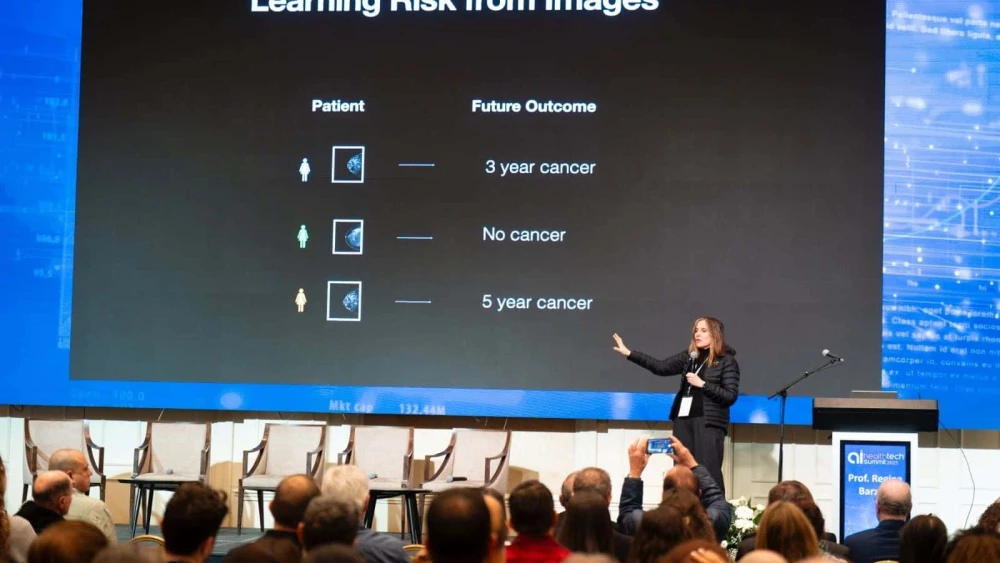
A state-of-the-art AI system capable of detecting a patient’s risk of developing breast cancer is expected to be launched in Israel in 2026 in a worldwide first, a Massachusetts Institute of Technology (MIT) computer science professor said on Wednesday.
The new technology and another for detecting lung cancer, which is simultaneously being tested in both Taiwan and Croatia, highlight the spread of artificial intelligence in the medical field, which experts say has the potential to revolutionize healthcare.
“By the nature of its organized and tech-savvy healthcare system, Israel has the potential to be at the forefront of the healthcare AI revolution,” MIT professor Regina Barzilay told JNS. “It will be a game-changer on many levels, and a very powerful tool to help early treatment.”
The Moldovan-born and Israel-educated Barzilay, who was the keynote speaker at the annual HealthTech AI Summit in Tel Aviv this week, appears on TIME Magazine‘s 2025 listing of the top 100 AI leaders.
Barzilay’s academic focus on AI and cancer detection began nearly a decade ago after she was diagnosed with breast cancer in her early 40s, with no family history of the disease, she recounted in the interview with JNS.
She would go on to develop AI tools that determine the likelihood of developing the disease within five years based on a simple mammogram, offering women the chance at early diagnosis, an easier treatment, and an increased survival rate, something which she herself did not have.
“AI is good at reducing uncertainties,” she noted, citing her own personal story that suddenly turned her own life upside down. “Think how blood tests and medical imaging helped change the way diagnoses are made and treatment is selected. This is like genetic testing on steroids.”
Breast cancer is the most common cancer in women, with most cases occurring in patients with no identifiable family history or specific gene mutation.
“Many women, even those who do mammograms regularly, are not diagnosed in time,” said Barzilay. “I think the technology can do a much better job than using our eyes.”
Then, when a friend in her 50s suddenly died from lung cancer after a persistent cough, the Israeli-American academic turned her sights on the leading cause of cancer death and created another AI model, which predicts six-year lung cancer risk from a patient’s low-dose CT scan.
“I found myself in projects where I can use my skills to make a difference,” said Barzilay.
AI cancer screening models have yet to be adopted in the United States, she said, noting that the incorporation of any new technology “takes a long time.” However, AI breast cancer screening is expected to be adopted in Israel next year in cooperation with Clalit Health Services and the Hadassah Medical Centers.
“We are proud to be working with Professor Regina Barzilay on groundbreaking breast cancer screening studies of significant global importance that will hopefully allow us to turn these insights into care practice, as we already do in other validated domains,” said professor Ran Balicer, Chief Innovation Officer and Deputy Director General at Clalit, who chaired the HealthTech AI Conference in a statement sent to JNS.
He noted that over 100,000 individuals with Clalit alone (one of Israel’s four HMOs) already receive AI-driven care each month.
“We are actively using state-of-the-art scientific tools to provide our patients with predictive, proactive, and individualized care, a major move from the existing reactive and uniform care that is the mainstream of modern healthcare,” he said.