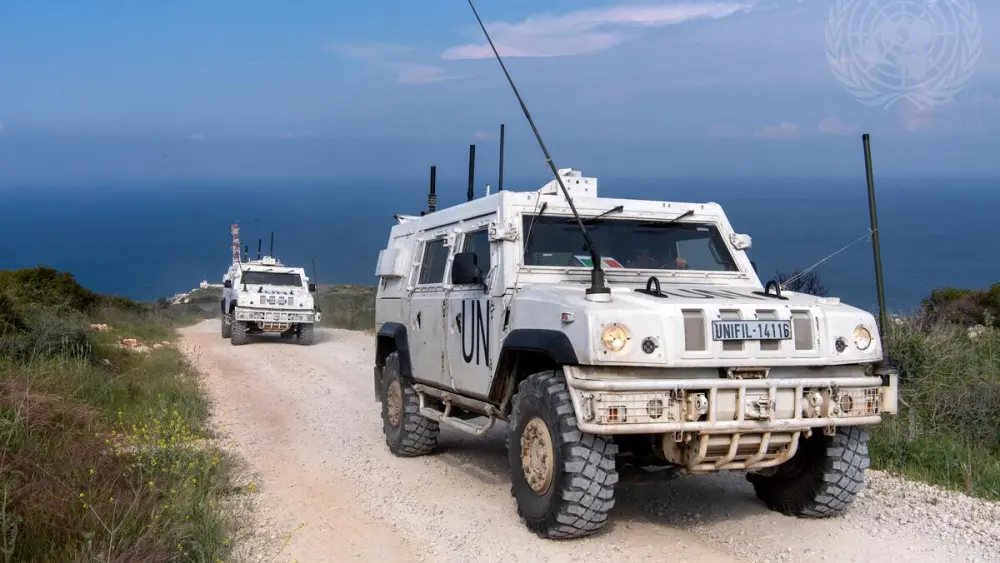
The U.N. Interim Force in Lebanon (UNIFIL) may continue some of its operations in Southern Lebanon, despite its mandate expiring at the end of the year, Prime Minister Nawaf Salam told the Associated Press on Friday.
France is preparing to introduce a resolution at the U.N. Security Council that would permit the peacekeeping force to continue some of its functions, such as clearing mines, escorting humanitarian convoys and monitoring violations, Salam was quoted as saying.
It is unclear for how long UNIFIL will maintain its presence in Lebanon, but continued operations during a drawdown period “will give us some extra time to agree on a new architecture,” the prime minister said, adding that Washington could be “open to considering” such an arrangement.
The U.N. Security Council unanimously voted on Aug. 28, 2025, to extend UNIFIL’s mandate for one last time until Dec. 31, 2026. The decision came after the U.S. and Israel pushed to terminate the peacekeeping force’s stay, citing Hezbollah’s military buildup under its watch.
Hezbollah “has expanded its military presence, stockpiled weapons, and constructed tunnels from Lebanon into Israel—an abject failure of a mission existing since 1978,” the U.S. State Department said in a Congressional Budget Justification report released in June 2025.
In addition, the terrorist group carried out nearly a year of almost daily attacks on Israel during the recent Israel-Hamas war before the Jewish state dismantled much of its leadership and military infrastructure.
UNIFIL’s withdrawal of roughly 8,000 military personnel and 600 civilian staff is set to take up to a year.
With the backing of the United States, the governments of Israel and Lebanon reached a Trilateral Framework on June 26 that aims to end the conflict between the two countries, calling for the disarmament of all terrorists groups within Lebanese territory.
But talks have stalled since then on the backdrop of the Israeli elections and the uncertainty about the Jewish state’s next government, Salam told AP on Friday.
He added that making definitive plans is difficult in the Middle East, citing the wider conflict with Iran as “directly affecting the situation in Lebanon.”
Beirut retains open lines of communication with Hezbollah and Iran, but will not “allow the future of the country to be contingent on Iran’s wishes,” he said, according to AP.
The Shi’ite proxy group that has sustained severe blows in its war with Israel since the Hamas-led invasion into the northwestern Negev on Oct. 7, 2023, seems to be “more and more dependent on Iran,” Salam continued.
“Definitely we are not seeking confrontation with Hezbollah. But we will not succumb to the intimidation of Hezbollah,” he added.
Hezbollah has rejected calls to lay down its weapons, threatening to respond with force to any attempts to compel it to do so.
Danon: ‘The era of UNIFIL is over’
Speaking to JNS on Aug. 18, Israeli Ambassador to the U.N. Danny Danon said that Israel supports “the implementation of the Security Council resolution to end UNIFIL’s mandate in Southern Lebanon, but we oppose the deployment of new international forces in the area. We must not repeat the grave mistake of UNIFIL.”
Taking to X on Nov. 17, the Israeli diplomat declared that “the era of UNIFIL is over.
“The security of Israeli citizens will not be entrusted to any ‘international force,’” Danon wrote.
On Nov. 15, U.S. Ambassador to the United Nations Mike Waltz arrived in Beirut as part of a three-day visit to Lebanon and Morocco.
“Lebanon has a real opportunity to chart a sovereign, secure future,” the envoy wrote on X. “America is here to support that, and to be clear about what it takes.”
Waltz said he had come to “hear the truth about the transition and next steps” of U.N. forces and aid agencies.
Washington, Jerusalem and Beirut are seeking alternative arrangements that would allow at least a partial withdrawal of Israel Defense Forces troops from Southern Lebanon while preventing the Iranian-backed terrorist organization from reestablishing a foothold there.
JNS has learned that one of the leading proposals under consideration involves deploying international private security contractors to assume responsibility for these areas.
France, however, continues to advocate extending the multinational peacekeeping force’s operations, albeit under a revised mandate.