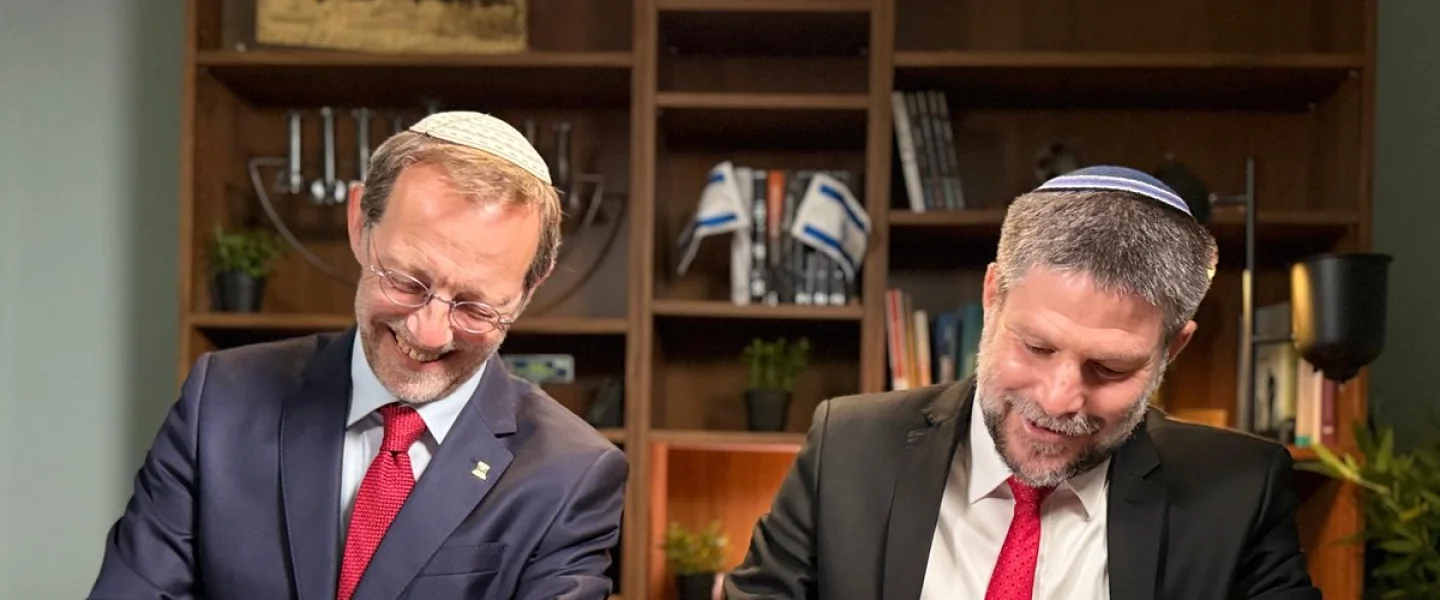
The Religious Zionism and Zehut parties won six seats on a joint ticket in Israel’s Oct. 27 election, bringing together Finance Minister Bezalel Smotrich and former Likud MK Moshe Feiglin.
Their alliance combines two strands of the Israeli right: Smotrich’s emphasis on religion and settlement, and Feiglin’s Jewish nationalism and libertarianism.
Announced on Sept. 1, the agreement sought to prevent either party’s votes from being lost below the electoral threshold. Both retained their separate identities under a technical bloc that allowed them to split after entering the Knesset.
On Nov. 17, Feiglin submitted a formal request to establish Zehut as a separate, one-member Knesset faction. The request followed the terms of the parties’ pre-election agreement, although formal approval of the split had not been confirmed as of Nov. 25.
The parties
Smotrich’s party grew out of the National Union–Tkuma joint list. Although Religious Zionism inherited a formal rabbinical committee from its predecessor, its contemporary leadership operates primarily through Smotrich and the party’s elected institutions. Senior Religious-Zionist rabbis continue to advise its leaders on major political and ideological questions.
The party adopted the Religious Zionism name in 2021. It advocates strengthening Jewish education and the state’s Jewish character, expanding settlements in Judea and Samaria, and opposing territorial concessions. Its joint list with Otzma Yehudit and Noam won 14 seats in 2022, seven belonging to Smotrich’s party. He subsequently became finance minister and an additional minister in the Defense Ministry, gaining substantial authority over civilian affairs in Judea and Samaria.
Feiglin founded Zehut (“identity” in Hebrew) in 2015 after serving in the Knesset with Likud. The party paired support for Israeli sovereignty over Judea and Samaria with free markets and greater individual choice. It received 2.74% of the vote in April 2019, falling short of parliamentary representation. Following the death of his grandson, Sgt. Yair Levin, in battle in Gaza, Feiglin declared his intention to run in January 2025.
For Feiglin, the party’s commitments to “liberty” and “identity,” its two ideological pillars, are closely connected. “Fundamentally, if you don’t have your identity, you don’t have your freedom,” he told The Jerusalem Post in January 2025. Since Oct. 7, he has argued that stronger Jewish identity must also underpin a change in Israel’s governmental and security doctrine.
The joint slate was dominated by Religious Zionism candidates, with Smotrich first and Feiglin second. Settlements and National Missions Minister Orit Strock followed, with judicial-reform leader Simcha Rothman fourth. Tzvika Mor, leader of the Tikva Forum and father of former hostage Eitan Mor, was fifth, followed by reservist commander Itamar Eitam. Zehut also fielded Rabbi Yitzhak Zaga in eighth place and reservist officer and “Generation of Victory” leader Omer Patziniach Waldman in 10th.
The election gave Religious Zionism five of the alliance’s six seats, with Feiglin occupying the remaining seat for Zehut.
The platform
Religious Zionism and Zehut both advocate Israeli sovereignty and settlement in Judea and Samaria and oppose Palestinian statehood. Smotrich has pursued that agenda in office, advancing the E1 settlement project between Jerusalem and Ma’ale Adumim, with the stated aim of preventing a Palestinian state. Furthermore, an estimated 259 new outposts, including 186 farming outposts, have been established since Smotrich entered office in 2022; the government has also approved more than 100 settlements, including through retroactive legalizations.
Feiglin supports Smotrich’s settlement program in Judea and Samaria but wishes to expand it to Gaza. He advocates annexing Gaza, removing its Palestinian population and rebuilding Israeli settlements there.
Both parties seek to reduce judicial constraints on elected government. Religious Zionism’s September program would separate the attorney general’s advisory and prosecutorial functions, allow ministers to appoint their legal advisers and restrict who can petition the High Court. An override clause would let the Knesset reinstate legislation struck down by the court.
“The government will be able to govern, the Knesset will be able to legislate,” Smotrich said when announcing the plan. Zehut separately proposes electing Supreme Court justices directly every 10 years and barring the court from overturning Knesset laws.
Religious Zionism generally advocates free-market economics, emphasizing lower taxes, reduced regulation, greater competition and dismantling monopolies. Its approach also incorporates state intervention, including childcare subsidies, proposed taxes on bank profits and public investment in settlements and religious institutions. Smotrich has combined market liberalization with targeted spending to advance social, religious and national priorities.
Zehut’s economic program, by contrast, leans more capitalist, aiming to reduce taxes, regulation and state control. It proposes a low, uniform income-tax rate, lower corporate taxes, removal of import barriers and an end to agricultural production quotas. Its housing proposals would dismantle the Israel Land Authority’s monopoly, privatize land and distribute it to Jewish citizens, while transferring planning powers to local authorities and communities. It presents these changes as a means of lowering living costs.
On education and religion, Religious Zionism emphasizes Jewish education and the state’s Jewish character. Zehut favors parental and community control, proposing publicly funded school vouchers. Zehut also advocates reducing compulsory core-curriculum requirements, while denying vouchers to schools that forgo core studies entirely.
Military service reveals a further distinction. Smotrich supports exemptions for full-time yeshivah students while requiring other eligible Haredi men to enlist. In May, he conditioned support for exemption legislation on Haredi leaders endorsing that requirement. Zehut advocates at least one month of compulsory basic training for all men, regardless of background, with annual refresher service, and a transition toward a professional army.
Both Religious Zionism and Zehut advocate strengthening Jewish sovereignty and expanding Jewish worship rights on the Temple Mount, challenging longstanding restrictions on Jewish prayer. Smotrich has called for a synagogue on the Mount, although he does not personally visit it. Zehut explicitly calls for Jewish prayer rights, recognition of the Mount as Judaism’s holiest site and removal of the Islamic Waqf, which currently administers it. Feiglin frequently visits the Temple Mount and advocates increased Jewish visits to the site.
The partners
Religious Zionism–Zehut won six seats in the Oct. 27 election, contributing to the 53 seats secured by parties aligned with Prime Minister Benjamin Netanyahu. The bloc fell eight seats short of the 61 required for a governing majority.
The alliance’s principal prospective coalition partners are Likud, Shas, United Torah Judaism and Otzma Yehudit. However, negotiations between Likud and Gadi Eisenkot’s Yashar party over a possible national unity government have introduced uncertainty about the roles Smotrich and Feiglin might play in the next coalition.
Smotrich has emphasized settlement expansion, Israeli sovereignty in Judea and Samaria and the party’s judicial-reform program, which he has made a condition for joining the next coalition.
Feiglin has declared his intention to demand the Defense Ministry, arguing that Israel needs a fundamental change in security strategy. Zehut candidate Yitzhak Zaga has said the party would refuse to join a government led by Netanyahu unless it committed to conquering Gaza, expelling its residents and reestablishing Jewish settlements there.
Both parties committed to recommending Netanyahu as prime minister before the election. On Oct. 6, Likud signed a surplus-vote agreement with the joint list, allowing it to cooperate in allocating remaining Knesset seats after the initial distribution.
Both parties have rejected joining a government led by the opposing “change” bloc, although neither has explicitly ruled out cooperation with every party within it.
Their political relationship entered a new phase on Nov. 17, when Feiglin submitted a formal request to the Knesset Arrangements Committee to separate Zehut from Religious Zionism.
The request was consistent with the agreement signed by Smotrich and Feiglin ahead of the election, which allowed their parties to run together while retaining the option of forming separate parliamentary factions.
Feiglin asked that Zehut be recognized as an independent, one-member faction, leaving the remaining five lawmakers to represent Religious Zionism.
The proposed separation would give Feiglin greater freedom to pursue Zehut’s priorities in coalition negotiations, particularly its positions on Gaza and the Defense Ministry, without requiring Smotrich to adopt all of its demands.
As of Nov. 25, formal recognition of the split had not been independently confirmed.
The parties’ combined six seats secured parliamentary representation, but the Netanyahu-aligned bloc lacks a majority, and the possibility of a Likud–Yashar unity government could limit their influence.
For Smotrich and Feiglin, the challenge is to determine how their separate political agendas can be advanced in a Knesset where neither the right-wing bloc nor its principal opponents command a governing majority.