Scotland’s top elected political leader defended anti-Israel protesters who gathered outside a synagogue last week, and later avoided answering whether he agreed with banners calling Zionism a form of racism.
A lawmaker asked John Swinney, Scotland’s first minister and leader of the Scottish National Party (SNP), in the Scottish parliament about the Nov. 22 protests outside Glasgow’s Giffnock Newton Mearns Synagogue, where anti-Israel protesters showed up to demonstrate against an event about Jewish immigration to Israel.
“I want to make clear that the right to peaceful protest must be expressed on all occasions, and that approach will be taken to the handling of any of these matters,” Swinney, who has accused Israel of committing “genocide” in Gaza, said in parliament when asked about the protest. He noted that local Jews had staged a counterprotest against the anti-Israel rally.
Scottish Jews condemned authorities’ decision to allow the anti-Israel protest to go forward, arguing it was a form of harassment at a place of worship.
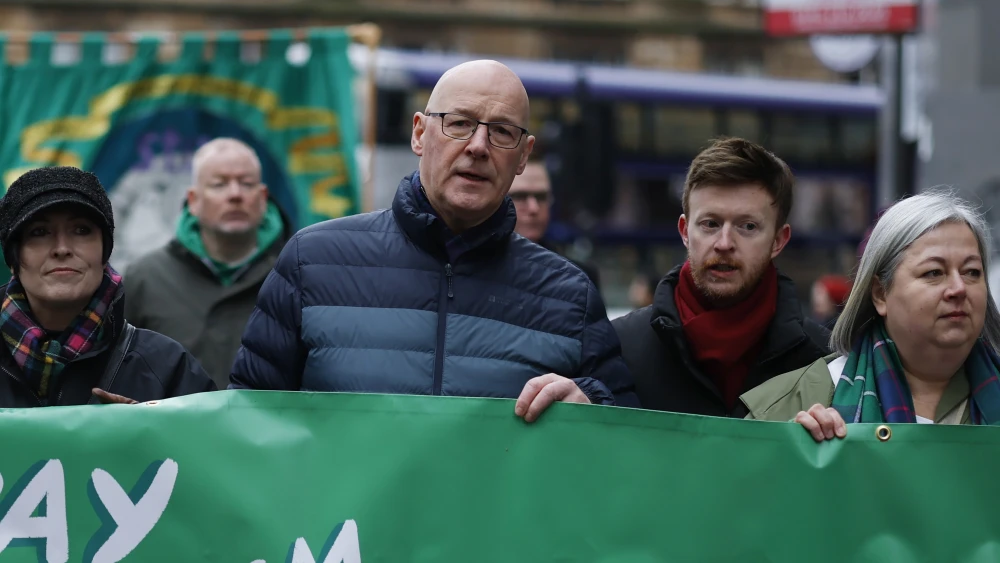
Over the weekend, Swinney gave an interview during what organizers called an anti-racism march, where a banner reading “Zionism is racism” appeared in the background.
Swinney was asked three times about the banners in a TV interview at the Scottish Trades Union Congress (STUC) Anti-Racism and Anti-Fascism march, the Jewish News of London reported.
Responding the first time he was asked about the banner, Swinney said the demonstration was “important” because it showed that “we have safe and inclusive communities for all in Scotland.” Scottish Press Association reporter Craig Meighan then said the words “Zionism Is Racism” on a large banner directly behind Swinney “muddied the waters of your message.”
Meighan pressed Swinney again about the banner, noting it was “in the shots right behind you.” Swinney said: “As first minister, I want to make it clear that I’m working hard to bring communities together, to stand up to the far right and make sure we’ve got safe and inclusive communities in Scotland.”
Scotland’s government, led by the SNP under Swinney, controls domestic affairs, including policing, education and health. The United Kingdom’s central government in London handles foreign policy, defense and immigration. SNP, which has been the ruling party in Scotland since 2007, advocates independence for Scotland from the United Kingdom. SNP is also involved in national British politics, with six lawmakers in the House of Commons out of 650 members.